
Healthspan vs Lifespan: How to Feel Better as You Age
September 1, 2026
Are you trying to live longer, or live better? Most of us have only ever stopped to think about the first one. But there’s a name for the gap between them—healthspan vs lifespan. Lifespan is the quantity, the years on the calendar. Healthspan is the quality, how good you feel while you’re living them.
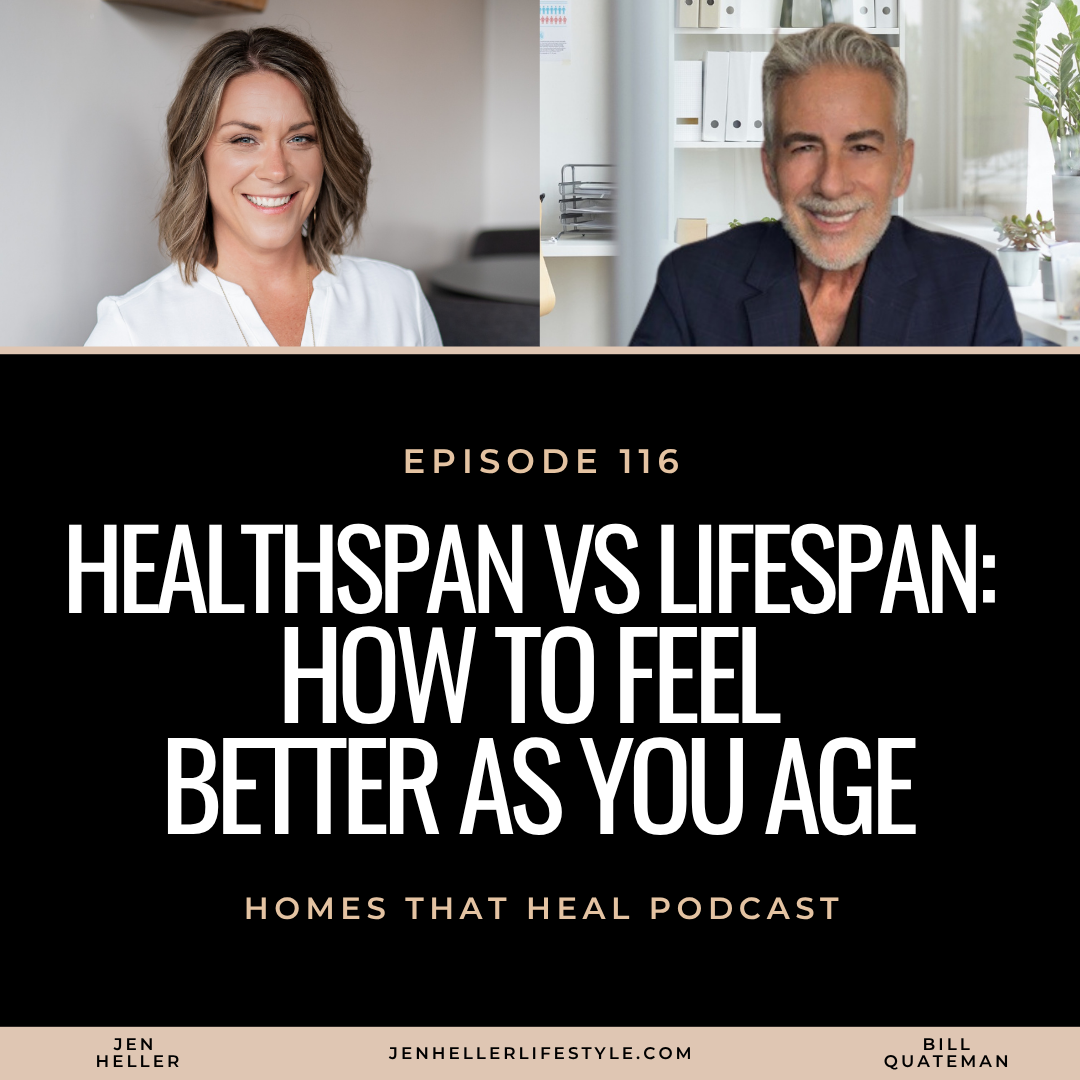
My guest, Bill Quateman, has spent three decades in the wellness world, and he has his own word for that quality: peak span.
He also has a way of explaining why so many of us feel foggy and flat even when our lab work says we’re fine. It all comes back to that split between quantity and quality. So let’s jump right in.
What Healthspan vs Lifespan Means
Picture two people who both make it to 85. One spends the last fifteen years tired, achy, and watching life from the couch. The other is still hiking, hosting Sunday dinners, and chasing grandkids around the backyard. Same lifespan. Wildly different healthspan.
That second version is what Bill means by peak span—your years lived in full color. And the hopeful part is how much of it sits in your hands. It’s shaped less by luck and more by the daily inputs your body has been quietly asking for.
Why We Lose Energy as We Age
That slow slide in energy we love to blame on “just getting older” often starts earlier than you’d guess—somewhere in your early 30s. It’s gradual, it’s sneaky, and most of us adapt to it without realizing how much ground we’ve handed over.
And a big piece of that puzzle? Minerals.
Minerals Are the Spark Plugs of Your Energy
Bill describes minerals as the spark plugs of your body—the tiny components that make everything else fire. Minerals are involved in nearly every process that turns food into usable energy, which means when they run low, you feel it.
Low minerals are associated with fatigue, brain fog, restless sleep, and that wrung-out feeling no amount of coffee seems to fix.
The tricky part is that mineral deficiency doesn’t always show up on a standard blood panel. Your labs can read “fine” while your body is quietly running on fumes.
Hair Tissue Mineral Analysis: Knowing Instead of Guessing
Most of us approach supplements like we’re throwing darts at a dartboard in the dark. We read an article, grab a bottle, and hope for the best. That is not a plan. That is expensive guessing, and analysis paralysis usually wins.
Bill’s answer is a hair tissue mineral analysis, or HTMA—a simple test you can do from home. A small hair sample gives a read on your mineral levels and how your body is working underneath the surface. He calls it the most foundational look at your own biochemistry, and the reason he leans on it is beautifully simple: it lets you stop guessing and start knowing.
Instead of taking twelve random supplements and hoping, you find out what your body is short on and address that. Knowing instead of guessing.
How to Start Closing the Gap
You don’t have to overhaul your life this weekend. Closing the space between healthspan vs lifespan is really about small, repeatable inputs that add up over time. Here is where Bill would have you start.
Small Ways to Close the Healthspan vs Lifespan Gap
Test before you add. A hair tissue mineral analysis (or working with a practitioner who runs one) takes the guesswork out of your supplement routine and points you toward what your body needs. Start there before you spend another dime on bottles.
Feed your body the basics. Real, mineral-rich food does more heavy lifting than any trendy powder. Bill is big on getting back to fundamentals before chasing the shiny stuff.
Mind your inputs. Your energy is the sum of what you take in—food, water, air, light, even your thoughts. Small upgrades in any of those categories compound.
Let Your Home Do Some of the Work
This is where my heart lives, you guys. Bill and I are cut from the same cloth here: your home is not just where you crash at night, it’s a tool that can support your healing.
Cleaner air, filtered water, morning light, a little grounding, fewer hidden toxins—none of it is complicated, and all of it takes pressure off your body so it can spend its energy on feeling good instead of playing defense. A home that supports you is one of the simplest ways to protect your healthspan for the long haul.
None of This Works Without You
All the testing and minerals and clean water in the world don’t do much if you’re not willing to show up for them.
He works from what he calls the four Ps—proactive, preemptive, preventive, and the one he says matters most, participation. The first three are strategy. The fourth is you, deciding to be an active driver in your own health rather than a passenger waiting to be fixed.
And that’s the sticky part, isn’t it? We live in what I like to call an “Amazon Prime mindset”—we want results by tomorrow with free shipping. Real change asks for something slower and less glamorous: showing up, day after day, and being willing to trade a little comfort for how you want to feel.
Nobody can participate for you, but once you do, everything else on this list starts to work.
The Real Win Is Feeling Good
If there’s one thing I hope you carry out of this episode, it’s that you have more say in how you feel than you’ve been led to believe. We’re all after good years—the kind where you wake up clear, steady, and glad to be in your body.
That’s the whole point of healthspan vs lifespan. And you can start today.
About Bill Quateman
Bill Quateman has studied holistic health and regenerative medicine for 30 years, including a 32-year tutorial under Dr. Bruce Boyd, a professor of psychiatry at Northwestern University. For more than two decades he has worked with and learned from some of the most progressive medical doctors and integrative regenerative medicine physicians in the field, and he consulted as a Health Coach on the set of the TV series NYPD Blue. Since 2000, Bill has been in business development in orthomolecular treatment, ozone therapy, and, more recently, stem cells, working alongside preeminent experts in cellular nutrition, including Dr. Abram Hoffer, one of the founders of orthomolecular medicine. His company, Advanced BioCell, is a concierge regenerative medicine resource that coaches and guides each person to create healing strategies in a toxic world. Find him at AdvancedBioCell.com.
Contact Bill Quateman
- AdvancedBioCell.com
- HighDoseOzone.com
- YourStemCellsforLife.com
- Instagram: @advanced.biocell
- LinkedIn: https://www.linkedin.com/in/bill-quateman/
Resources
- Take a peek at my Jen Recommends list to see more of my favorite products.
- Grab my FREE Home Wellness Checklist here for more tips.
- The newsletter is where I get a little more personal. If you’re not on the list yet, come join us.
- Join the Jen Heller Collective Waitlist
Disclaimer: This podcast is for general information purposes only and does not constitute the practice of medicine, nursing, or other professional health care services. The statements and views expressed are not medical advice and are not meant to replace the advice of your medical doctor. This podcast, including Jen Heller and her guests, disclaims any responsibility and any adverse effects you may experience from the specific use of the information contained herein. The opinions of guests are their own and this podcast does not endorse or accept responsibility for the statements made by guests. The content of this podcast is not intended to be a substitute for professional medical advice, diagnosis, or treatment. If you think you have a medical condition, consult your licensed physician.


