
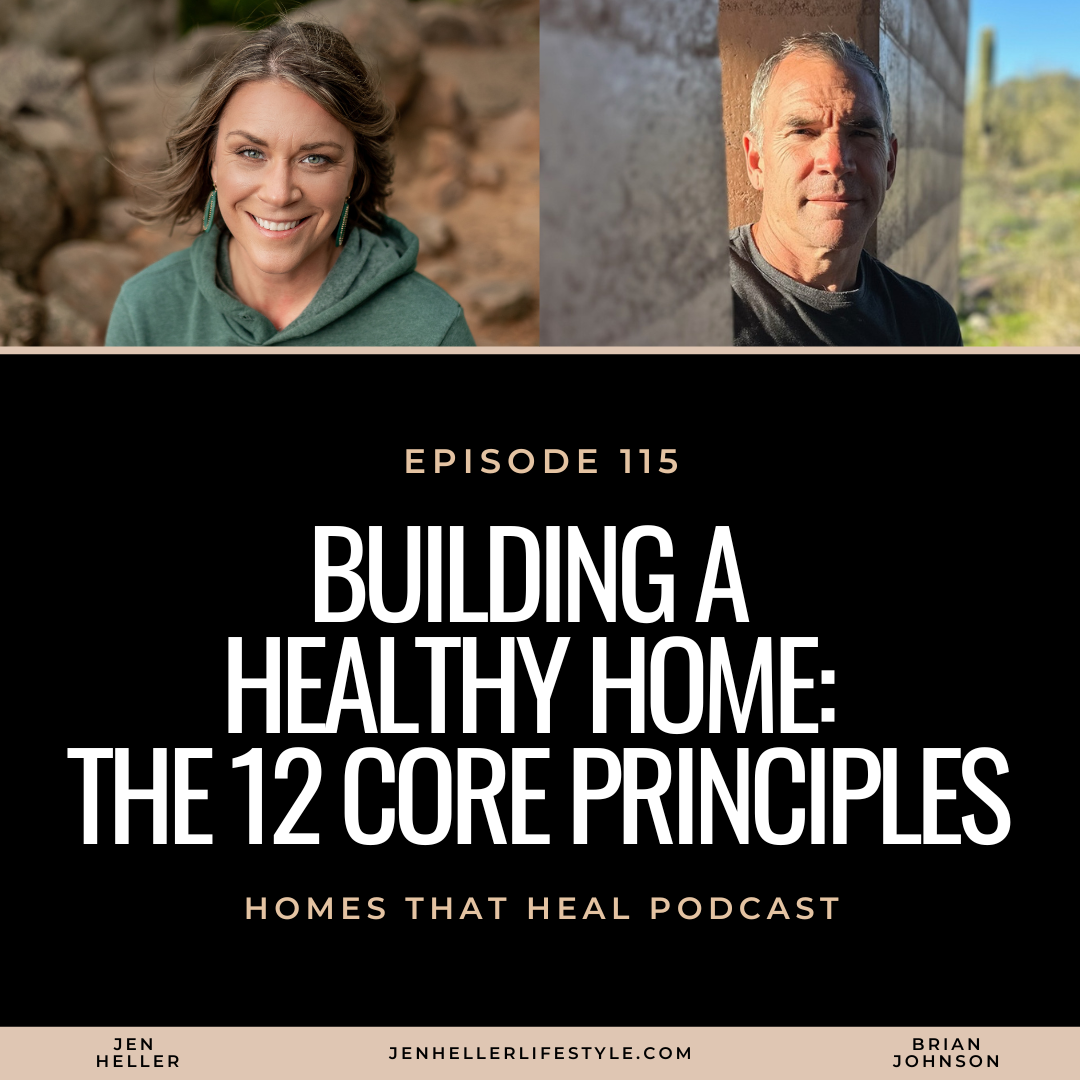
Building a Healthy Home: The 12 Core Principles
August 25, 2026
Walk into a house that feels good and you can usually sense it before you can explain it. The air is fresh, the light is easy on your eyes, and your shoulders drop about an inch. That feeling isn’t an accident. It’s the whole idea behind a healthy home, and my guest this week has spent two decades learning how to build it in on purpose.
Most of us come to a healthy home through the small stuff. We swap the candles, add a water filter, toss the plastic. All good moves. But builder and building biologist Brian Johnson will be the first to tell you that some of the biggest factors in a healthy home are hiding where you can’t see them: inside the walls, behind the outlets, and in the air you’re breathing right now.
The good news? You don’t need a demolition crew to do something about it. Whether you’re dreaming up a new build or working with the home you already have, there’s a starting point for you.
Meet Brian Johnson
Brian is a general contractor, builder, and triple-certified building biologist, and the founder and CEO of Senergy 360. He’s spent more than two decades in construction, from earthquake- and fire-resistant concrete homes to high-performance healthy builds.
His whole approach traces back to one uncomfortable discovery early in his career: mold growing in the lumber before it ever became a house. That moment sent him down a rabbit hole of asking a bigger question. If the materials themselves can carry a problem into your home, what else are we not paying attention to?
The answer became a 12-part framework, and a mission to build homes that don’t just shelter you, but support how you feel inside them.
What a Healthy Home Really Means
Here’s the reframe Brian offers: a healthy home isn’t defined by one product or one upgrade. It’s the sum of a lot of systems working together.
Think about how much of your life happens indoors. You sleep there, eat there, and for many of us, work there too. The air, water, light, and materials around you are inputs your body is responding to around the clock. A healthy home simply means designing those inputs to support you instead of quietly taxing you.
That’s a different goal than most of the building world is aiming for.
Where Building Science Meets Building Biology
There are two worlds that, oddly enough, rarely talk to each other.
Building science is about performance: how a house holds up, how energy-efficient it is, how the structure behaves over time. Building biology is about people: how the home affects the health of the humans living in it.
Brian’s frustration, and mine too, is that a home can earn top marks for energy efficiency and still be a difficult place for a sensitive body to live in. He points out that LEED, the best-known green-building rating system out there, was designed mostly around energy and resource efficiency. The name spells it out: Leadership in Energy and Environmental Design. What it wasn’t built around is the wellbeing of the person on the couch. His work sits in the overlap, which is why he describes what he does as building “beyond LEED.”
The 12 Core Principles of a Healthy Home
Brian pulls all of this together in what he calls his Core Design Framework: twelve systems that work as one. Here they are in plain English.
- Architectural and home design. A floor plan and orientation that support your health from day one.
- Building performance envelope. The walls, roof, foundation, and drainage that keep moisture and the outside world where they belong.
- Building materials. Non-toxic, breathable, mold-resistant choices instead of whatever’s cheapest on the truck.
- Electrical systems. Wiring designed to keep EMFs low from the start.
- Lighting systems. Circadian-friendly light that works with your body clock instead of against it.
- Water filtration. Treatment matched to your home’s actual water, throughout the whole house.
- Low-voltage systems. Hardwired setups that cut down on wireless signal bouncing around your rooms.
- Clean power technologies. Solar, filtered power, and backup for cleaner energy coming in.
- Mold prevention. Moisture control and inspection so mold never gets a foothold. (This is where Brian’s whole story began.)
- Climate control. Heating, cooling, ventilation, and humidity handled as one connected system.
- Plumbing design. A healthy plumbing strategy running behind the walls.
- Home furnishings. Non-toxic sofas, textiles, and finishes for the surfaces you touch every day.
Every one of these systems matters, and they matter even more together than apart. Let me zoom in on a few that come up most with my listeners.
Water: filtration and structured water
Whole-home water filtration is a foundational piece for Brian, and a non-negotiable in my book. He’s also a fan of structured water, the idea that water can hold a more organized, life-supporting state. It’s one of those places where what a lot of us feel is running a few steps ahead of what the studies have measured, and I’m here for that kind of curiosity. Start with clean, filtered water, then explore from there.
EMFs and dirty electricity
This is a big one for me. Brian breaks electromagnetic fields into four categories, including radio frequency from our wireless devices and something called dirty electricity, the electrical “noise” riding along your home’s wiring. The research is still catching up, but plenty of us can feel the difference when we lower the exposure, and Brian designs to reduce it wherever it’s simple to do, especially in the bedroom where your body does its overnight repair work.
The energy of a healthy home
Beyond the measurable stuff, Brian talks about the energy of a space, the way a home feels once all the pieces come together. He goes there with quantum energy, harmonizers, and the sense that a house carries a frequency of its own, and if you’ve been around here a while, you know I’m all in on this layer. Call it woo if you want. I call it the part you feel in your body the second you walk through the door. A truly healthy home tends to its energy as much as its air ducts.
Why This Matters, Even If You’re Not Building
You are always in relationship with your home. Every night you sleep in it, every meal you make in it, your body is taking cues from the environment around you. Small, steady inputs add up over years. That’s not meant to scare you. It’s meant to hand you some agency, because it also means small, steady improvements add up in your favor. A cleaner air supply here, better sleep lighting there, and over a year those choices compound into a home that works with you instead of against you.
Small Steps Toward a Healthier Home
You don’t have to gut your house. If this topic feels big, start here.
Open your windows regularly and consider a quality air filter, especially in the bedroom. Add a water filter you’ll keep up with. Swap harsh bulbs for warmer, flicker-friendly lighting, and dim things down in the evening. Create a little distance from wireless devices while you sleep, even just moving your phone off the nightstand. And the next time you paint, re-carpet, or renovate, ask about lower-VOC, lower-toxicity options before you buy.
Pick one. Live with it. Add the next when you’re ready.
You Don’t Have to Start From Scratch
If there’s one thing I hope you take from this episode, it’s that a healthy home is built one decision at a time, and you can start exactly where you are, with whatever budget and square footage you’ve got.
Brian’s work is a beautiful reminder that our homes can be active partners in our health. You don’t need his whole 12-principle blueprint to feel the difference. You just need a place to begin.
About Brian Johnson
Brian Johnson is a general contractor, builder, and triple-certified building biologist, and the founder and CEO of Senergy 360. He designs homes as living systems that account for clean air, pure water, healthy light, low-toxicity materials, and EMF-conscious wiring, all packaged into a 12-principle framework he calls building “beyond LEED.” He’s also building the Healthy Building Alliance, a platform connecting healthy-home experts and homeowners, and developing the Element, a community of 20 wellness-focused homes north of Tucson.
- Find Brian: senergy360.com
- Brian’s Core Design Framework: senergy360.com/services/core-design-framework
- The Healthy Building Alliance: healthybuildingalliance.org
- Instagram: instagram.com/senergy360
Resources
- Take a peek at my Jen Recommends list to see more of my favorite products.
- Grab my FREE Home Wellness Checklist here for more tips.
- The newsletter is where I get a little more personal. If you’re not on the list yet, come join us.
- Join the Jen Heller Collective Waitlist
Disclaimer: This podcast is for general information purposes only and does not constitute the practice of medicine, nursing, or other professional health care services. The statements and views expressed are not medical advice and are not meant to replace the advice of your medical doctor. This podcast, including Jen Heller and her guests, disclaims any responsibility and any adverse effects you may experience from the specific use of the information contained herein. The opinions of guests are their own and this podcast does not endorse or accept responsibility for the statements made by guests. The content of this podcast is not intended to be a substitute for professional medical advice, diagnosis, or treatment. If you think you have a medical condition, consult your licensed physician.


