Non-Toxic Home Design for Better Air, Light & Sleep
November 24, 2026
“You can’t save the planet if you’re sick in bed.” Interior designer Kristin Kilmer would know. She was designing eco-friendly homes in California when she started getting sick herself, and it took her a while to see the connection. As she puts it, we teach what we most need to learn. It’s the reason she’s spent more than 20 years on non-toxic home design.
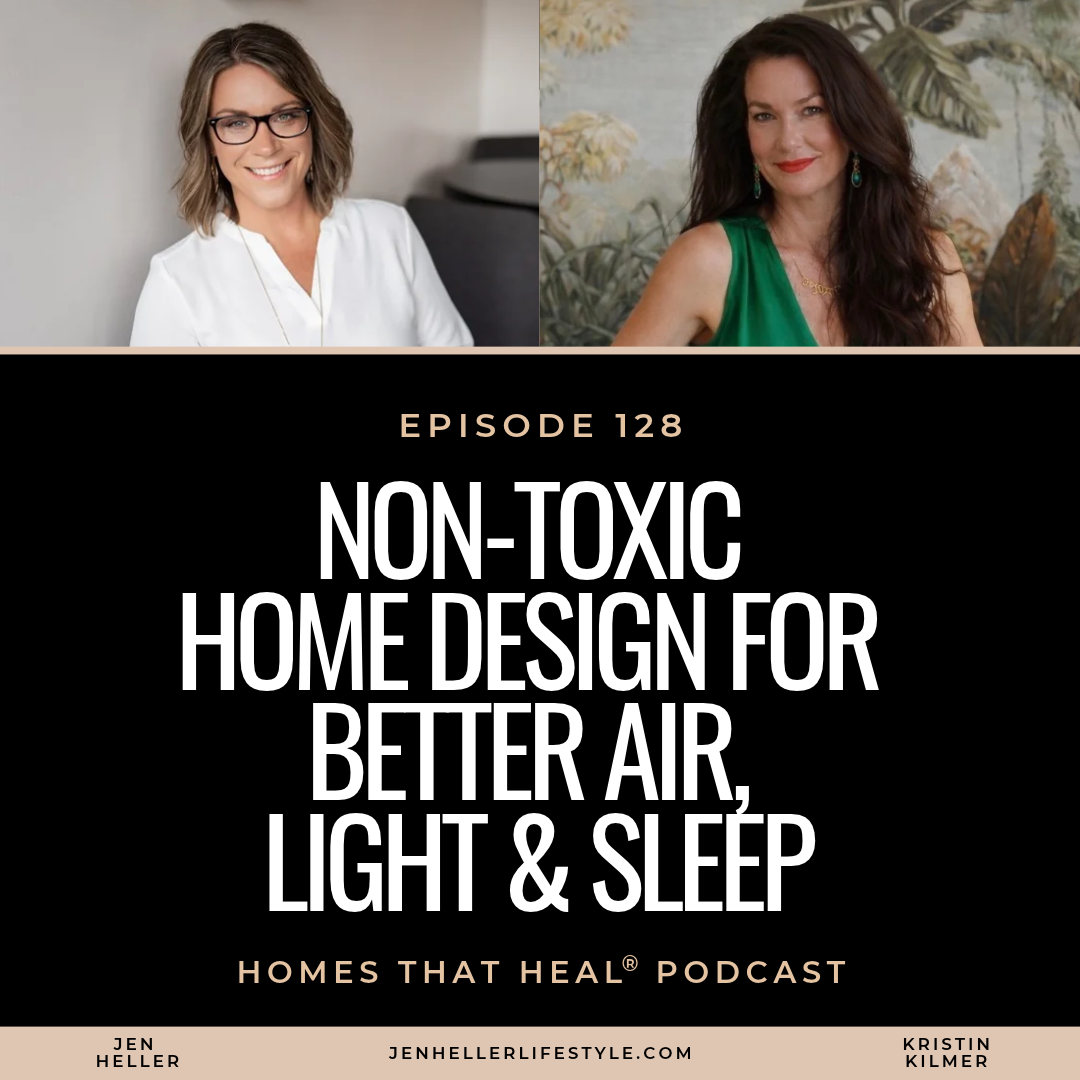
Kristin joined me on Homes That Heal® to chat about the air you breathe, the light you live under, and the bedroom you sleep in. Most of what she recommends is simple, and plenty of it costs nothing at all.
What Is Non-Toxic Home Design?
Non-toxic home design means choosing materials and furnishings that support the health of the people living with them. It covers what your sofa is made of and what’s been sprayed on it, along with the quality of your air, your water, and your lighting.
It also starts with how a space feels. You know the difference the second you walk into a room that feels calm and easy to breathe in, and that feeling is usually the first clue that the materials are working with you.
Where Green Design Falls Short
Green building focuses on the planet, with goals like energy efficiency and renewable resources. Those goals matter, but a home can check every green box and still be full of materials that off-gas into the air you breathe.
Kristin saw this firsthand in the early 2000s, when she designed for an energy-efficient prefab home showcased at the TED conference. Videos from its display at a Las Vegas builder show revealed rooms filled with furniture she could tell, just by looking, was mostly plastic.
Labels can be just as misleading. Kristin once asked a vendor to send only non-toxic samples, and the “eco” fabrics that showed up had been treated with fire retardants. Her reaction sent her into anaphylactic shock.
Conscious Luxury: Beauty and Health in the Same Room
Kristin calls her approach conscious luxury. It means asking where a material comes from and what chemicals went into making it. Recycled polyester sounds like a smart choice, for example, until you ask whether it came from a closed-loop process and what was burned to produce it.
A beautiful home and a healthy home can absolutely be the same home. Asking better questions is how you get both.
Every Home Is Bioindividual
Kristin uses a word we both picked up at the Institute for Integrative Nutrition: bioindividuality. Just like our bodies, our homes have different needs.
One of Kristin’s clients reacts to any smell at all, including latex and other materials common in healthy homes, so she uses zero-odor, CertiPUR-US certified products. Another client handles smells just fine but is so sensitive to electromagnetic fields that granite countertops bother her. Some of Kristin’s clients are sensitive enough to react to the glue holding a sofa frame together.
That’s why there’s no universal checklist. A good place to start is noticing where and when you feel off at home, then looking for the root cause in that space.
Kristin also points out that as your body clears out what it’s been carrying, you may notice things you used to tolerate, like plug-in air fresheners or fabric softener on hotel sheets. I bring my own pillow and pillowcase when I travel by car for exactly that reason.
Use the Elements as Your Guide
Kristin designs with five elements: earth, air, fire, water, and metal. Chinese medicine divides earth into earth and wood and doesn’t include air, but Kristin adds air from the Western side because air quality matters so much. Three of the elements make especially good starting points for non-toxic home design.
Air: Clean Up What You Breathe
Kristin points out that indoor air is often considerably worse than outdoor air, and her first fixes are mostly free. Taking your shoes off at the door keeps outdoor particles from traveling through your house, which is why she counts it as both an earth practice and an air practice.
Candles are another easy swap. Kristin avoids soy wax because of how it’s processed and because soy is a monocrop, and she reaches for beeswax or coconut wax scented with essential oils instead. If your HVAC system isn’t great, a quality air purifier is worth the investment.
Water: Look Past the Kitchen Faucet
Most people think about drinking water and stop there. You also shower, bathe, brush your teeth, and clean with the water coming into your home.
Kristin adds a detail that’s easy to miss. In an unfiltered shower, you’re breathing in the steam, so a good shower filter is a smart first step if a whole-house system isn’t in the budget. She suggests choosing one whose filter media holds up to high heat, and she likes Natural Action Technologies for structured water filters.
My husband and I moved out of the city years ago partly for this reason. We have well water now, which gives us more control over what comes into our home. We know exactly where it comes from, and we test it ourselves.
Fire: Rethink Your Lighting
In Kristin’s approach, the fire element covers lighting, candles, and EMFs. Lighting may be the most overlooked part of a healthy home.
Blue light after dark may interfere with melatonin, the hormone that helps you sleep, and that part is fairly well known. Fewer people realize that even warm-toned LED bulbs can flicker. You may never see it, but Kristin believes your body still registers it.
For her own home, Kristin has used incandescent bulbs and Chromalux, a full-spectrum bulb made in Sweden. She also likes ColorBeam, a circadian lighting system that moves from morning light to daytime light and down to amber and red at night. For a smaller budget, she’s tested non-flicker bulbs from Waveform and Norb lighting.
You can start tonight without buying anything. Switch your phone to a red light setting, wear blue-blocking glasses in front of screens, and dim the lights after dinner. Nearly every room in our house has a dimmer, and following the sun that way makes winding down so much easier.
Non-Toxic Home Design Starts in the Bedroom
I’ll die on this hill: your bedroom should be for rest. Movie theaters and home offices belong somewhere else. If you’re going to start anywhere, start with your bedroom and your kiddos’ rooms, since that’s where your body does its recharging.
Turn Off What You Don’t Need at Night
Outlet cutoff switches plug into the wall and let you shut off the power behind your bed. Kristin says you can find them on Amazon for about $15.
If you need Wi-Fi for work, put the router on a timer the same way you would Christmas lights. Kristin tried a kill switch first and kept forgetting to use it, and the timer solved that.
She also recommends avoiding metal bed frames, which she says can amplify electromagnetic fields. Kristin says most homeowners can opt out of a smart meter, and renters with a shared wall behind the bed can look into a shielding product.
Sleep on Good Linen
Linen sheets are one of my favorite bedroom upgrades. We sleep on linen most of the year and switch to organic cotton when it gets cold.
Quality matters here. Lower-grade linen can feel scratchy, while good French or Belgian linen softens with every wash. Kristin says a quality set can last 20 years, which makes the upfront cost easier to swallow.
Leave Delivery Boxes at the Door
Kristin was the first person to ever bring this one up with me. She keeps delivery boxes and plastic wrap out of her house because, she says, they can carry chemicals and mold from wherever they’ve been sitting. Our boxes get opened outside now, too.
Kristin builds this habit into every home she designs with a mudroom. You sit on a bench, take your shoes off, and drop boxes in a closet next to a recycling spot. When a home makes the healthy choice the easy one, it sticks.
Clear Out Before the Holidays
Before you bring anything new into your home, Kristin recommends letting some things go. The stuff you don’t use collects dust and particulate matter, and it can carry memories and emotional weight, too. If it’s a big job, ask a friend to help, because feelings tend to come up.
Wellness Gifts for a Healthier Home
Clearing space also makes room for gifts that support the people you love. A few ideas from Kristin and me:
- Coconut wax or beeswax candles scented with essential oils
- A nebulizing diffuser, which disperses essential oils without heat
- Organic cotton castor oil packs
- Linen sheets or linen towels
- Bath salts
- Outlet cutoff switches as stocking stuffers
- A bench or basket for an entryway box drop
- A sunrise alarm clock, which lets you wake to birdsong with your phone outside the bedroom
- Gift certificates to businesses working to support people and the planet
Pro tip: Saunas ship as freight, so an order placed the week before Christmas won’t make it in time. If yours won’t arrive by the holidays, wrap up a photo of it with a set of linen towels.
Start With One Room
Kristin wants your home to feel like a retreat every single day. You don’t have to know everything to get there. As she puts it, we don’t know what we don’t know, and once you do, you can make one better choice at a time.
Pick one room, start with the free swaps, and build from there. That’s how non-toxic home design works in real life.
About Kristin Kilmer
Kristin Kilmer is a holistic interior architectural designer and wellness expert with over 20 years of experience creating homes that support health, vitality, and transformation. Her work integrates Building Biology principles, conscious non-toxic design, elemental design, and intuitive wellness consulting to address the aesthetic, environmental, and energetic dimensions of a space. Rooted in her own healing journey from Lyme disease and mold toxicity, Kristin brings a deeply personal understanding of the relationship between the built environment and human well-being. Her approach transforms homes into refined, restorative energetic sanctuaries: beautiful spaces designed to elevate the residents within them. Based in Laguna Beach, Kristin serves clients nationally and is collaborating with Brian Johnson of Synergy 360 on healthy-home projects across the U.S., including Element, an innovative wellness-focused residential development in Arizona.
Links & Resources
- Visit Kristin’s website: kristinkilmer.com
- Follow Kristin on Instagram
- Connect with Kristin on LinkedIn
- Book a complimentary 20-Minute Conscious Luxury Home Design Discovery Call
- Book a two-hour Conscious Luxury Home Intensive
- Take a peek at my Jen Recommends list to see more of my favorite products.
- Grab my FREE Home Wellness Checklist here for more tips.
Be the first to know about my new favorite wellness tools, special deals, and more, subscribe to our newsletter!
Disclaimer: This podcast is for general information purposes only and does not constitute the practice of medicine, nursing, or other professional health care services. The statements and views expressed are not medical advice and are not meant to replace the advice of your medical doctor. This podcast, including Jen Heller and her guests, disclaims any responsibility and any adverse effects you may experience from the specific use of the information contained herein. The opinions of guests are their own and this podcast does not endorse or accept responsibility for the statements made by guests. The content of this podcast is not intended to be a substitute for professional medical advice, diagnosis, or treatment. If you think you have a medical condition, consult your licensed physician.


