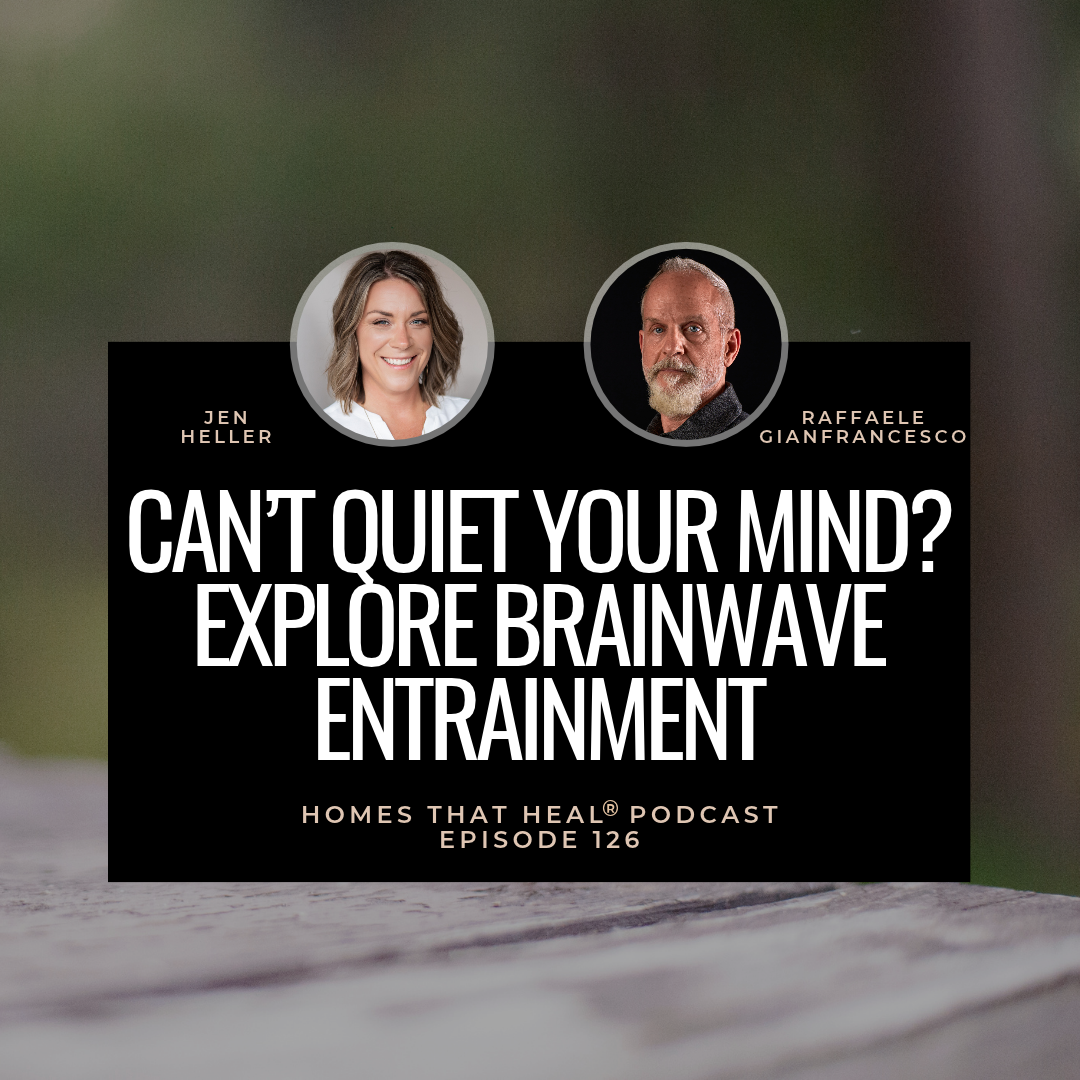
Picture me lying on a table in the middle of a crowded conference hall, hundreds of people shuffling past, my morning coffee still very much in my system. I figured there was no way I’d quiet my mind in a room like that. Within a minute, the crowd had disappeared. I was drifting through color and music, and by the time the session ended, tears were running down my face. That was brainwave entrainment at work, and I knew I had to get Raffaele Gianfrancesco of roXiva on Homes That Heal® to help me understand what was going on in my brain that morning.
Meet Raffaele Gianfrancesco
Raffaele grew up in an Italian immigrant family that ran a landscaping business, which meant every Saturday and every summer went to hauling and mowing alongside his dad and uncles. He decided pretty early that he wanted to work with his brain and his mouth instead of his hands. He trained in electronics in the ’80s, moved into tech sales because he was even better at explaining the technical stuff than building it, and eventually landed on Wall Street.
Then the tech bubble burst in 2000, and in his words, he lost his shirt. Around that time, he realized how much trauma he’d been carrying, and that realization led him to neurofeedback, and eventually to the flickering light device he now helps bring to the world as Global Sales Manager for roXiva Innovations.
When I first met him, I told him about my own history with brain injury and asked him, point blank, whether this device could help someone like me. Within a few minutes he’d explained it in plain English, and I was on the table.
What Is Brainwave Entrainment?
Brainwave entrainment is the whole category of tools that use rhythm to nudge the brain toward a different state. The roXiva device pairs pulsed light and sound with vibration, and Raffaele says the goal is to guide people into what he calls coherent and flow states. Some people describe it as being in the zone. Others describe a sense of deep peace, or feeling like they traveled somewhere for a few minutes.
How the Brain Follows Frequencies
The idea rests on something called the frequency following response. As Raffaele explains it, your brain wants to match its environment. Give it a steady rhythm, and it tends to fall in step.
You already know this feeling, even if you’ve never heard the term. Think about the last great concert you went to, or a movie with a sound system so good you could feel the bass in your chest. For a couple of hours, you stopped thinking about your inbox. Raffaele points to the same thing happening with sports fans, and I’ll admit that even I, a woman who is not a soccer fan by any stretch, noticed how completely people got swept up in the World Cup.
Why It’s So Hard to Quiet Your Mind Right Now
Raffaele has a theory about why so many of us struggle to sit still with our own thoughts, and it starts with the phone in your hand.
When You Can’t Meditate
For a long time, meditation was the go-to way to step outside the chatter in your head. But Raffaele says it’s getting harder and harder for the average person to pull off. Between screens and notifications, he says our attention spans have been trained down to roughly the level of a goldfish, so the kind of meditation that came easier ten years ago takes a lot more effort today.
If you’ve ever sat down to meditate and spent the whole time wondering whether you were doing it wrong, that might be a relief to hear. Tools that use rhythm and coherent signals, he says, may give the brain something to follow so it doesn’t have to do all the work alone.
The Racing Mind and the Voice in Your Head
Full disclosure, it’s not always easy for me to settle down, especially with people around, and I can get in my own head fast. I call it my monkey mind. Raffaele calls it the narrator, the ego, the voice that keeps a running commentary on everything you do.
His take is that we’re so bogged down by that voice that we’ll grab almost anything that switches it off for a while. Some of those things are healthy, like a craft you love or a workout that puts you in the zone. Some of them, he points out, are a lot less helpful. The appeal is the same either way, which is a quieter mind.
My First Session on a Crowded Expo Floor
My session lasted about eight to ten minutes, and I went in more worried about the setting than anything. Lights, noise, strangers everywhere. If I had to put a time on it, I’d say I was “in” somewhere between 30 and 60 seconds.
What came next is hard to put into words. I remember colors and music, and the feeling of floating in a meadow. It felt like I was being held, almost like Mother Earth herself had me. The photos from that morning show me looking like I was in the most peaceful sleep of my life, which is quite a trick after a cup of coffee. When it was over, I was sad to get up. There were other people in line, of course, but I wasn’t ready.
What People Mean by a “Drug-Free Psychedelic Experience”
I’d heard the roXiva experience described as a “drug-free psychedelic experience,” and that phrase made me curious and a little nervous. I’ve never done psychedelics. Part of that is I was never that drawn to them, and part of it, if I’m being vulnerable, is fear. With my brain injury history, I’ve always wondered what something like that might do to me.
Raffaele thinks the word psychedelic gets misused. In his view, a psychedelic experience is any experience that lets you detach from that ever-present voice in your head. Breathwork can do it. Getting lost in an art you love can do it. He adds that the biggest fear people have around psychedelic substances is the loss of control, since once you’ve taken them, you’re on the ride until it’s over.
He also has a big-picture explanation for what’s happening. Our brains, he says, are built for survival, and they take shortcuts by filtering out anything they decide isn’t important. When that filtering process gets interrupted, he believes it opens the door to coherence and neuroplasticity.
More Connected Than Relaxed
When I described my session as relaxing, Raffaele pushed back, gently. He asked whether I felt more connected than relaxed, or more whole.
I had to sit with that for a second, and he was right. What I felt was heart-centered and tuned in to my own body, with nothing else going on around me. Raffaele’s point is that we tend to describe our inner lives in pairs, like stressed or relaxed and happy or sad, and those pairs leave out a lot. He says it’s common for people to tear up after a session because they’ve never felt anything quite like it. I can vouch for that one.
It reminded me of something I hear all the time from people shopping for infrared saunas. They read hundreds of other people’s opinions in forums and Facebook groups and wonder if they’ll feel the same thing. My answer is always that your experience is yours, and it’s worth trusting what you feel over what a stranger online tells you to feel.
Raffaele’s Story: Finding Joy Again
When Raffaele started neurofeedback, it worked. He learned to tamp down his fight-or-flight response and stop being so reactive. But once he’d spent some time in that calmer place, he noticed something was missing. He didn’t have access to joy.
Looking back, it made sense to him. His parents were immigrants who didn’t speak the language and were scared much of the time. They raised their kids to stay hypervigilant and to worry about what other people would think. That wiring, he says, kept him safe and also kept childlike wonder at arm’s length.
He shared a Carl Jung line: you can only go as high up into heaven as you’re willing to go deep down into hell. Oof. That one landed. Limiting your pain, in Raffaele’s view, tends to limit your happiness right along with it.
These days he says he’s “in the awe and wonder business.” He described visiting a friend’s baby, who feels everything all the way, joy and anger alike, and then grabs its feet and does the happiest little leg split you’ve ever seen. His wish is simple: don’t let anyone take that away from the kid.
So many of us get caught up in work, routines and shuttling kids around that we forget what joy feels like. Raffaele’s story reminded me of my conversation with Dr. Patrick Porter, who talked about how we start out wide open and spend years learning to shrink and fit into a box.
What People Report After a Session
I asked Raffaele for stories, and he had plenty. He says he’s heard from people with aphantasia, who usually can’t picture anything in their mind’s eye, telling him they saw images for the first time. Others who believed they only dreamed in black and white reported seeing color. Some describe out-of-body experiences or lucid dreaming, and some say they felt a loved one who has passed come through with a message.
These are personal reports, and everyone’s experience is different. Raffaele’s summary is that when you get the thinking brain out of the way, surprising things tend to happen.
Is Brainwave Entrainment Safe for Kids?
I wanted to ask this one before we wrapped up, since kids are part of so many of our homes. Raffaele was straightforward with me: young brains are so pliable that they may be more receptive to seizures, so as a company, roXiva doesn’t recommend the device for kids and keeps it to adults.
Ways to Quiet Your Mind This Week
You don’t need a device to start. Raffaele says coherence can come from your breathing or from music just as it can from flickering light and vibration, which means some of this you can try tonight from your own couch.
A good first step is noticing where you already lose yourself. Think about the last time you went a whole hour without checking your phone, whether it was at a concert, a ballgame or a project you couldn’t put down. Raffaele would call that a flow state, and it’s a pretty good clue about where your quiet already lives.
If sitting in silence to meditate leaves you feeling like you’re failing a test, start with your breath instead. He counts breathing among the simplest paths to coherence, and it asks a lot less of a busy brain than trying to empty it on command.
Then ask yourself the question Raffaele’s story left me with: what brings you joy right now, and when did you last make room for it? If you need a minute before you can answer, that pause is worth paying attention to.
Whatever you try, give yourself permission to feel what you feel without checking it against anyone else’s experience. Some of this can’t be put into words, because it’s a feeling and a state of being, and the only opinion that counts is yours. So go inward, and ask yourself what might help you expand it.
About Raffaele Gianfrancesco
Raffaele (“Raffa”) Gianfrancesco is an entrepreneur, philosopher, consciousness explorer, and wellness technology innovator with a lifelong passion for understanding human potential. With a background in philosophy, meditation, energy healing, and breathwork, he bridges ancient wisdom with emerging technologies. As Global Sales Manager for roXiva Innovations and a NeurOptimal practitioner, he focuses on technologies that support consciousness exploration, personal transformation, and well-being. Curious by nature and entrepreneurial in spirit, Raffa is particularly interested in the intersection of science, spirituality, technology, and human evolution.
Links & Resources
- Learn more about roXiva at roXiva.com
- Take a peek at my Jen Recommends list to see more of my favorite products.
- Grab my FREE Home Wellness Checklist here for more tips.
Be the first to know about my new favorite wellness tools, special deals, and more, subscribe to our newsletter!
Disclaimer: This podcast is for general information purposes only and does not constitute the practice of medicine, nursing, or other professional health care services. The statements and views expressed are not medical advice and are not meant to replace the advice of your medical doctor. This podcast, including Jen Heller and her guests, disclaims any responsibility and any adverse effects you may experience from the specific use of the information contained herein. The opinions of guests are their own and this podcast does not endorse or accept responsibility for the statements made by guests. The content of this podcast is not intended to be a substitute for professional medical advice, diagnosis, or treatment. If you think you have a medical condition, consult your licensed physician.


