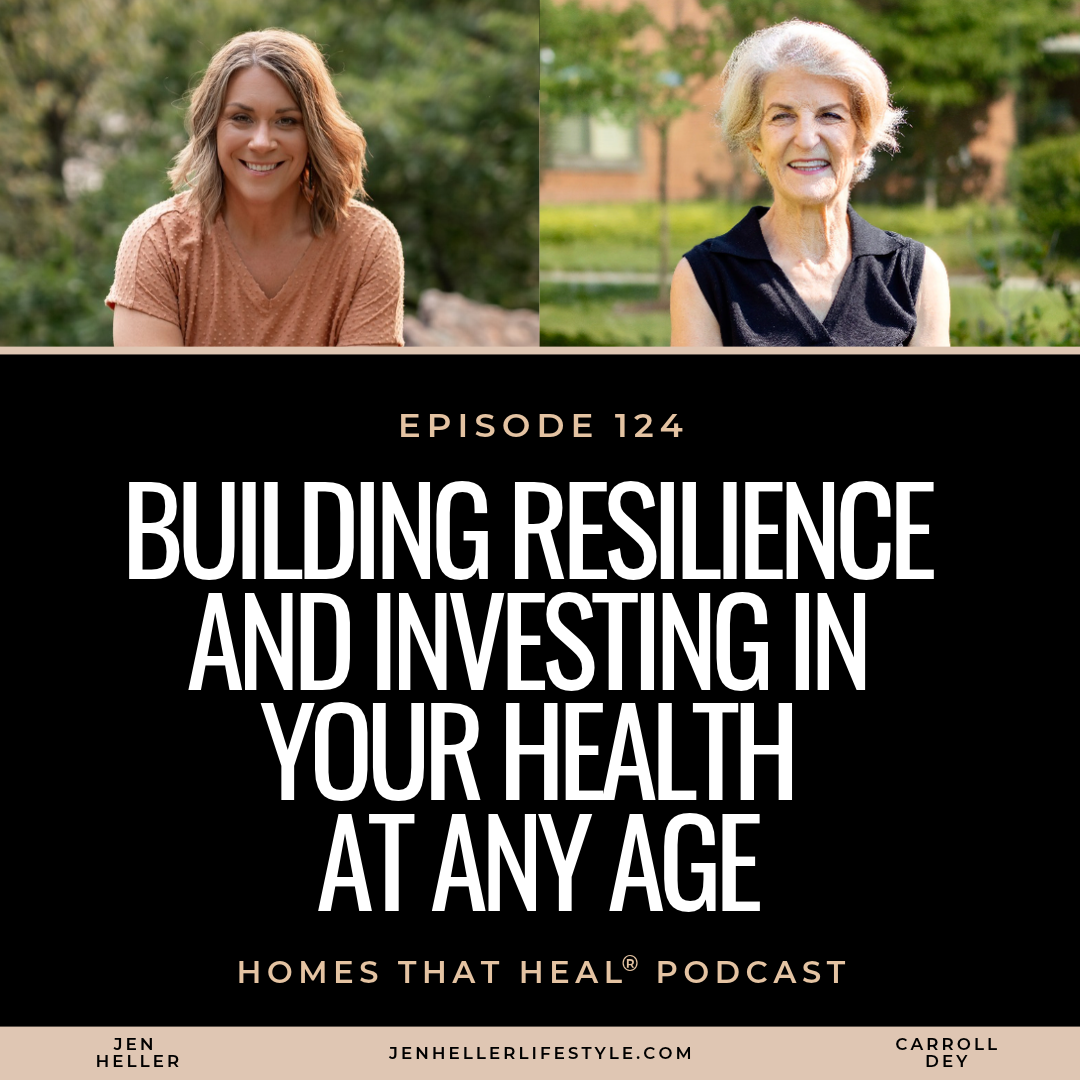
You can start investing in your health at any age, and my friend Carroll Dey is my favorite proof. She found her voice at 70, and just this year, she wrapped up four months of brain training. It all started in 1999, when a driver ran a red light and hit her while she was out for a jog.
So this week on Homes That Heal®, Carroll and I talked about how she rebuilt her body after the accident that changed everything, and what she’d tell anyone who’s in a hard season right now.
Meet Carroll Dey
Carroll has called Washington, DC home for more than 40 years. She spent two decades in wine importing and sales before moving into real estate, and she now guides clients as a member of Sotheby’s International Realty. She’s also a speaker guided by the principles of The Go-Giver, and she’s getting ready to publish a book on resilience.
We met a few years ago on a rooftop in West Palm Beach, at a table full of strangers drinking mocktails. Bob Burg, co-author of The Go-Giver, ended up sitting with us, and by the end of the night it felt like we’d all known each other forever. Carroll and I have been trading voice messages ever since.
Carroll’s Story: Rebuilding After a Car Accident
In 1999, Carroll had just filed for bankruptcy after losing everything to a con man she’d been dating. A few months later came the jog that changed everything.
When she regained consciousness, she was on the other side of the street, and she says she heard God tell her, “Your life will never be the same.” She spent a month in the hospital with a broken right leg and ligament damage in her left. A concussion from that day still affects her vision. To this day, she has never had surgery.
After my stroke in 2014, I spent a couple of years angry and frustrated, trying to figure out why it happened to me. It took time, and the right people, before I could see that it happened for me. Carroll has landed in the same place. As she put it, “We are who we are because of these experiences.”
Investing in Your Health Starts Where You Are
Carroll worked out her whole life before the accident. She was a performing arts major in college, and she was running and training regularly. Afterward, she had to start over from scratch.
Her first workouts happened in her gym’s pool. While she was still in a cast and couldn’t bear weight, she lowered herself into the water from a walker and walked laps, 25 of them, because she was born on the 25th. Water can take a lot of pressure off a healing body, and for Carroll, it was the place she could begin.
That’s the part of investing in your health we tend to skip. The first step usually looks like whatever you can manage today.
Find the Right Support for Your Body
Once she was back on land, Carroll’s first trainer put her on heavy weights, and she says it was the wrong fit for her body. A woman at the gym suggested she try a physiotherapist and trainer named Chris, and she’s been working with him ever since.
Chris focuses on the alignment of the body and customizes each client’s work to what that person needs. Carroll calls him “the body whisperer,” and she says many of his clients come to him after serious accidents, hoping to avoid surgery. She goes twice a week, and she credits that work with helping change her body metabolically.
When you work with someone who wants you to get better, it gets easier to show up for yourself. Carroll told me she doesn’t need the nudge, though. On the days she has a session, she’s up and ready. “It is the elixir to me,” she said.
Treat Your Body Like a Relationship
Carroll doesn’t own a scale. She eats what she wants (just not junk), and she grew up on fruits and vegetables thanks to her grandfather’s produce business.
She told me that if you treat your body the way you treat your friends, it works in order. In her experience, that care shows up in better sleep and a clearer mind. She compares it to putting oil in your car, and I love that, because it’s simple maintenance done consistently.
Resilience Takes Time, and That’s Okay
Carroll has wanted to write about her story since 2011, but she says it wasn’t time yet. She had more to go through first.
Her voice finally came out a few years ago, at a small-group gathering with Bob Burg in Jupiter, Florida, where each of seven guests had an hour to share their story. She planned to stay calm. Instead, she started sobbing, and soon everyone at the table was crying with her. They told her she had to share her story, and one man grabbed an easel and started sketching out a TED talk. That moment led her to become a Go-Giver speaker, which she calls the best thing she’s ever done.
The timing mattered to her for another reason. Carroll lost her father at 67, and as she approached that same age, it weighed on her. Around then, she says she heard him tell her, “I couldn’t get past 67. I’m handing you the baton, and now begins the best chapter of your life.”
I understand needing time. I hid my stroke for years, even from the people closest to me, because I wasn’t ready to say it out loud. Resilience doesn’t run on anyone else’s schedule. Sometimes the story has to sit with you until you’re ready to tell it.
Investing in Your Health at Home
Carroll has spent 30 years in DC real estate, and she lives in a second-floor apartment on about ten acres of land. There’s even a hiking path right outside her door. Her apartment doesn’t get much natural light, so she’s working on changes to bring more in. Meanwhile, she walks every morning right after sunrise, which she calls the best time of day to be outside.
With her clients, she has learned how emotional buying or selling a home can be. “It’s very much like being a shrink most of the time,” she told me. Most people move because something big is shifting in their lives, like a new job or a divorce, and Carroll sees her job as helping them find a space that feels right to them.
She’s also seeing more buyers leave the city for the suburbs around DC, like Bethesda and Arlington, because they want a yard and some green space of their own.
Mark and I spent about ten years in the city flipping houses, and something always felt like it was missing. One day I was lying in our backyard grass, hearing the traffic and looking up at the wires and poles, and it finally clicked. My nervous system was overloaded and overstimulated. Today we live on acreage, and our lives are completely different. Time outside and in green space is associated with lower stress, and getting your bare feet in the grass is one of the simplest ways to start.
Investing in Your Health in a Hard Season
I saved my biggest question for last: what would Carroll tell someone who’s in a hard season and doesn’t feel strong right now?
Her answer started simple. “You have two choices. You can go down or you can come up.” Here’s what coming up looks like for her.
Move in a Way That Feels Good
Carroll loves to work out, and she says she feels reborn after a session or a morning walk. Even holding the side of the pool for leg lifts gives her a buoyancy she can’t get anywhere else. Your version might look completely different, so find the movement that leaves you feeling better than when you started.
Get Quiet and Go Within
For Carroll, faith has changed her more than anything, and she’s clear she won’t tell anyone who to believe in. Her practice is to get quiet and meditate, remembering that “the noise is the noise.” She also writes in a gratitude journal to work through her thoughts and come back to center.
Protect Your Peace
The day before we recorded, Carroll received a letter about a real estate deal. The first sentence was so toxic that she stopped reading and sent a copy to the other agent involved. Then she tore it up. “I don’t have the bandwidth for this,” she said.
For her, that’s new behavior. Noticing what triggers you and stepping back before it gets in is a big part of coming back to center.
Learn to Love Yourself
“I finally learned to love myself,” Carroll said. It took her a long time to get there.
It reminded me of an exercise I did at a women’s retreat. You stand six inches from a mirror, look into your own eyes, and keep saying “I love you” until you feel it. It’s a simple practice, and it can open something up.
Investing in Your Health Includes Your Brain
Carroll has had four concussions. Four months before our conversation, she started brain training, beginning with a brain map followed by 30 sessions, twice a week. She’s still waiting on her final results, but she believes the work is part of why she can speak about her story so clearly now.
On her last day, the man she trained with told her he’d never met anyone like her, because so many people quit. She didn’t.
Why Investing in Your Health Pays Off at Any Age
Near the end of our conversation, Carroll said there was one word she wanted my listeners to hold onto: investment. “To change your body and your being and your life is an investment,” she said. “Once you make the decision to invest in yourself, everything will go into flow.”
She’s honest that it can take money. More than anything, though, she says it takes you, and a willingness to change.
Carroll’s story is proof that your best chapter can still be ahead of you, whatever your age and whatever you’ve been through. Investing in your health can start with something as small as a walk after sunrise, and it can keep paying off for decades.
Carroll Dey Bio
For more than 40 years, Carroll Dey has called Washington, DC home. After two decades in wine importing and sales, she moved into real estate, where she has built her business on trust and a commitment to serving others. Today she guides clients as a member of Sotheby’s International Realty. Carroll is also a speaker guided by the principles of The Go-Giver, sharing her story of rebuilding after a life-altering accident to encourage others in hard seasons. She serves on the leadership council of Sitar Arts Center and has volunteered with organizations including Children’s Hospital and N Street Village. Her book on resilience is on the way.
Links & Resources
- Carroll’s website: carrolldey.com
- Instagram: @carrolldey
- Facebook: Carroll Dey
- LinkedIn: Carroll Dey
- Take a peek at my Jen Recommends list to see some of my favorite products.
- Grab my FREE Home Wellness Checklist here for more tips.
Be the first to know about my new favorite wellness tools, special deals, and more, subscribe to our newsletter.
Disclaimer: This podcast is for general information purposes only and does not constitute the practice of medicine, nursing, or other professional health care services. The statements and views expressed are not medical advice and are not meant to replace the advice of your medical doctor. This podcast, including Jen Heller and her guests, disclaims any responsibility and any adverse effects you may experience from the specific use of the information contained herein. The opinions of guests are their own and this podcast does not endorse or accept responsibility for the statements made by guests. The content of this podcast is not intended to be a substitute for professional medical advice, diagnosis, or treatment. If you think you have a medical condition, consult your licensed physician.


