
How Nutrition Response Testing Finds Hidden Health Issues
June 16, 2026
Have you ever felt like something was off in your body, gone to the doctor, gotten a clean bill of health and walked out thinking, but why do I still feel terrible? You’re not imagining it. And you’re not alone. Nutrition response testing might be the thing nobody has told you about yet. It’s not a blood draw, it’s not a symptom checklist, and it’s nothing like a standard physical. But for a lot of people, including me, it’s the first thing that found the problem.
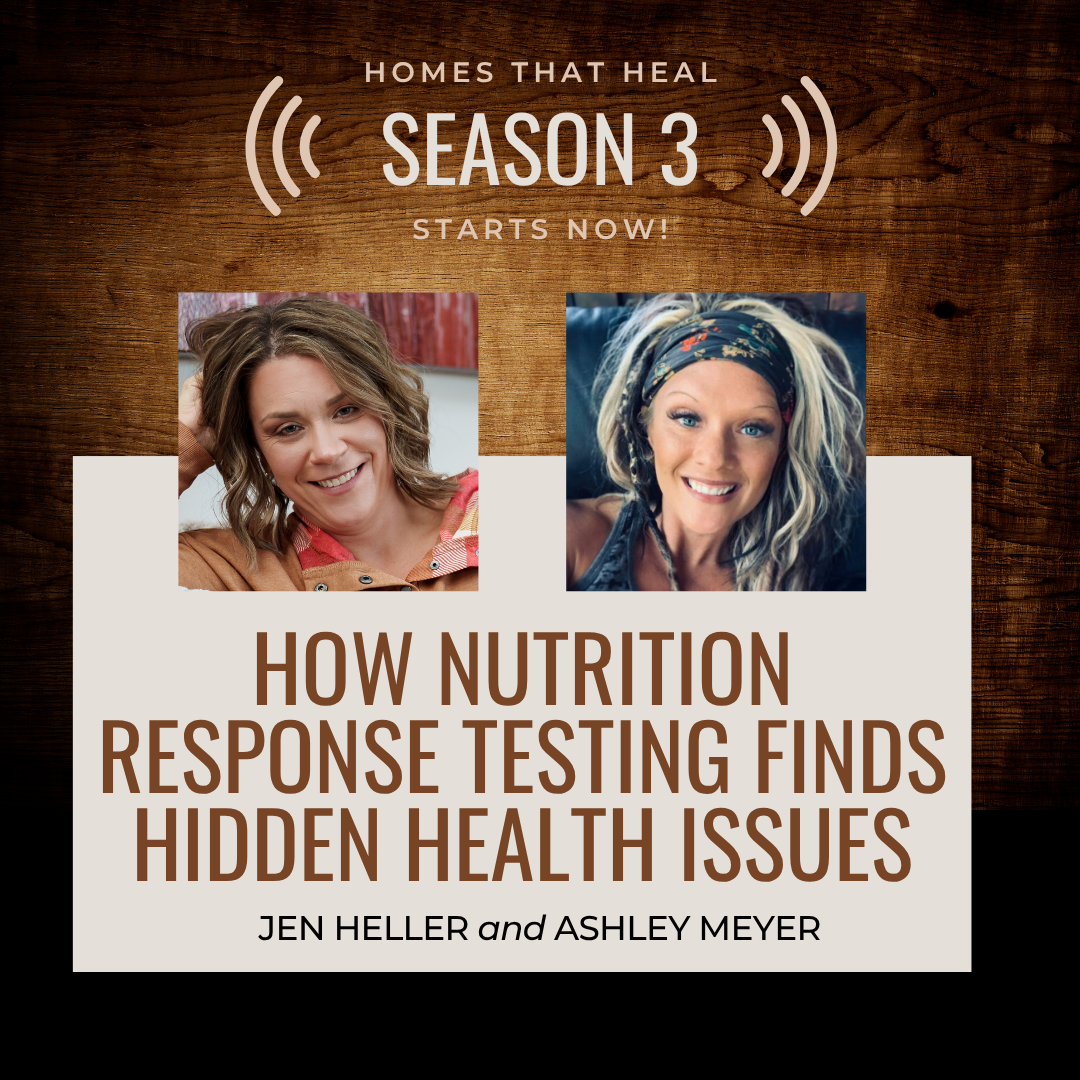
In Episode 105 of Homes That Heal, I sat down with my dear friend Ashley Meyer, one of only a few hundred practitioners in the country with the highest level of certification in nutrition response testing and designed clinical nutrition. Ashley has been one of the most influential people in my own health story for over a decade. And this conversation? Long overdue.
What Is Nutrition Response Testing, and How Does It Work?
Here’s the simplest way Ashley explained it to me, and it really clicked.
Think of your body as a building full of electrical outlets. When everything is functioning properly, you plug something in and the light comes on. When there’s a block somewhere—from heavy metal toxicity, a structural issue, an emotional pattern, an environmental toxin—the light doesn’t come on. Nutrition response testing is an electromagnetic evaluation that identifies which outlets aren’t working and, more importantly, why.
Ashley describes the body as a light being. We’re full of electricity. Your heartbeat shows up on an EKG. That energy is running through every organ, gland, and system all the time. NRT taps into that frequency and reads what the body is communicating. As Ashley puts it, the body doesn’t lie. Every symptom is information.
What Nutrition Response Testing Looks for in the Body
During a session, Ashley works through a systematic muscle-testing protocol while you lie on a table. Your body responds to different frequency inputs, and those responses guide her toward the root cause. She’s not guessing. She’s following the body’s own signals.
What makes nutrition response testing so different from most diagnostic approaches is the specificity. Two people can walk in with identical thyroid symptoms and have completely different root causes. One might have mercury toxicity from old dental amalgams. Another might have scar tissue creating a structural block, or an emotional pattern keeping the nervous system locked in a chronic stress response. NRT is designed to find the specific combination—what Ashley calls the “password”—that’s unique to each individual.
Her analogy for this is the combination lock. You can have the most advanced computer in the world, but without the right password, you can’t get in. The goal of nutrition response testing is to identify every number in that combination, in the correct order, so the nervous system can finally open up and let the body do what it’s designed to do—heal.
Heavy Metal Toxicity: The Root Cause Nobody Checked
Heavy metal toxicity is one of the most common findings Ashley comes across and one of the most consistently overlooked by conventional medicine. Metals like mercury and lead don’t always show up on standard panels, especially when they’ve settled into specific organs and glands or crossed the blood-brain barrier.
My own story is a pretty good example of this. When I first walked into Ashley’s clinic, I was significantly overweight, dealing with serious thyroid issues, and had already been told by multiple practitioners that my thyroid needed to be removed. I was in my twenties. I sat in my car and cried after that appointment, because I couldn’t wrap my head around removing an organ that my body was obviously given for a reason.
A friend handed me Ashley’s card and suggested I just go see what she says. I went in skeptical. I remember deciding I wasn’t going to tell her everything, because I wanted to see what she found on her own. Within fifteen minutes, she was walking me through heavy metal toxicity, mercury on the blood-brain barrier, and everything happening with my thyroid. I got emotional. And from that day forward, I trusted the process completely.
Why Re-Exposure Keeps So Many People Stuck
One of the biggest insights Ashley shares in this episode is the concept of re-exposure, and it’s a game-changer if you’ve ever done detox work and hit a wall.
Many people do all the right things—good nutrition, quality supplements, clean living—and still can’t get well. The reason, in a significant number of cases, is that the source of exposure hasn’t been identified or removed. You can support your body’s ability to detox, but if you’re still being exposed to the toxin every single day, progress will stall. In my case, Ashley couldn’t get my thyroid completely clear of mercury because I kept getting re-exposed. That’s when she started asking harder questions about environment.
Your Home Might Be the Missing Piece in Your Healing
Ashley noticed a pattern in her practice over the years. There were two groups of patients. Group A was responding, healing, getting results. Group B was doing everything right and staying completely stuck. The variable she kept finding in Group B? Their home environment.
The toxins she finds most frequently aren’t the obvious ones. Yes, mold is on most people’s radar. Mercury fillings are more widely known now. But refrigerant leaks, sewer gas, pesticide residue, and other odorless, flavorless, invisible substances show up in home after home—and standard home inspections usually don’t catch them.
How Nutrition Response Testing Applies to Your Home Environment
Ashley developed something called Quantum Environment Testing, where she uses the same frequency-based evaluation she applies to the body to assess a home for toxic disturbances. She can identify what’s present, where it’s coming from, and how significantly it’s affecting the body’s ability to heal.
Before I moved into my current home six years ago, Ashley tested it. What they found included a sewer gas leak in a media room that had sat vacant for years, plus issues with the gas line. Nothing was visible. Nothing had a smell. All of it would have been quietly working against my health from day one.
If you are doing everything right and still not getting well, your home deserves a serious look. No supplement protocol can outrun a daily re-exposure happening inside your own four walls.
Nutrition Response Testing and the Layers Most Practitioners Skip
Here’s what makes Ashley’s approach different from most practitioners: she doesn’t stop at the physical body.
In her clinical experience, the cases that have stumped everyone else—infertility, autoimmune conditions, autism, cancer, the “we don’t know what’s wrong with you” situations—almost always have more than one layer blocking them. Physical toxins, structural imbalances, emotional patterns, and spiritual misalignment can all show up as blocks in the nervous system. Nutrition response testing can identify which ones are present and in what priority order they need to be addressed.
When Nutrition Response Testing Finds an Emotional or Spiritual Block
This is the part that surprises people. Ashley has found, in many cases, that a person’s most significant nervous system block is tied to something emotional — unresolved grief, chronic fear, a life that’s out of alignment with what they’re meant to be doing. These aren’t metaphors. They show up as measurable energetic blocks, and until they’re addressed, the physical body can struggle to fully recover.
She delivers this information carefully and compassionately. But she’s also direct. That’s what I’ve always loved about her. She’s not going to tell you what you want to hear. She’s going to tell you what you need to hear, and then she’s going to help you figure out what to do about it.
A New Resource for Health Practitioners: Quantum Health Consulting
Through Quantum Health Consulting, Ashley now works directly with other providers to help crack their most difficult cases. She tests for blocks remotely and identifies the missing pieces that have kept a patient from responding, and then hands the findings back to the original provider so the patient relationship stays intact.
The idea is that practitioners shouldn’t have to refer their toughest cases away. They just need someone who knows how to find what hasn’t been looked for yet. For anyone working in natural health, functional medicine, or chronic illness care, this is worth exploring.
What to Take Away from This Episode
Healing isn’t always about doing more. Sometimes it’s about finally identifying the thing that has been in the way all along. The mercury quietly blocking a thyroid for a decade. The sewer gas no one thought to test for. The emotional pattern that keeps the nervous system locked in fight-or-flight no matter what else you try.
The body is built to heal. Nutrition response testing is one of the most thorough tools available for finding out what’s getting in the way.
About Ashley Meyer
Ashley Meyer is an ACT Certified Designed Clinical Nutritionist and the managing owner of ORGANIQUE Clinic, Spa & AVEDA Salon in Tomahawk, Wisconsin, a destination wellness retreat she built from the ground up over more than a decade of clinical work. She received her certification in Designed Clinical Nutrition and Nutrition Response Testing through Advanced Clinical Training at UNS in Clearwater, Florida, and is one of only a few hundred practitioners in the country recognized for the highest level of competency in the field. Her specialty areas include infertility, autoimmune conditions, autism, cancer, and the cases that have stumped every other practitioner. Ashley also offers Quantum Health Consulting for health providers working with complex, stuck cases.
Website: https://www.livingorganique.com
Quantum Health Consulting: https://www.livingorganique.com/qhc/
Facebook: https://www.facebook.com/OrganiqueClinic
Instagram: https://www.instagram.com/livingorganique/
Resources
- Take a peek at my Jen Recommends list to see more of my favorite products.
- Grab my FREE Home Wellness Checklist here for more tips.
- The newsletter is where I get a little more personal. If you’re not on the list yet, come join us.
- Join the Jen Heller Collective Waitlist
Disclaimer: This podcast is for general information purposes only and does not constitute the practice of medicine, nursing, or other professional health care services. The statements and views expressed are not medical advice and are not meant to replace the advice of your medical doctor. This podcast, including Jen Heller and her guests, disclaims any responsibility and any adverse effects you may experience from the specific use of the information contained herein. The opinions of guests are their own and this podcast does not endorse or accept responsibility for the statements made by guests. The content of this podcast is not intended to be a substitute for professional medical advice, diagnosis, or treatment. If you think you have a medical condition, consult your licensed physician.


