
Root Canals, Biological Dentistry & the Mouth-Body Connection
March 10, 2026
There’s a good chance your mouth is holding onto something your body’s been trying to tell you for years. That’s not woo — that’s anatomy and the basis of biological dentistry.
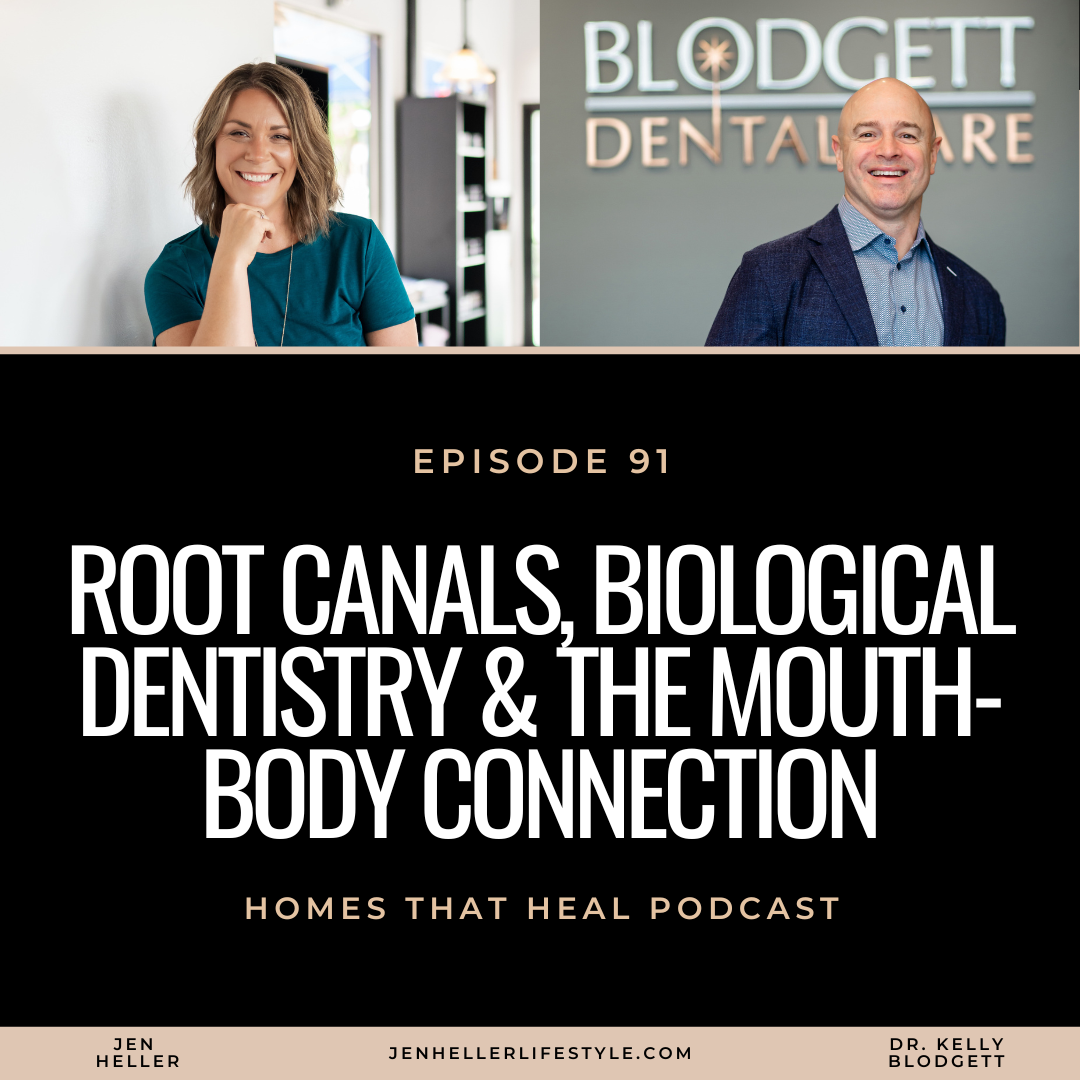
In Episode 91 of Homes That Heal, Dr. Kelly Blodgett — a biological dentist practicing in Portland, Oregon — and I talk about what’s really going on inside your mouth, how it connects to the rest of your body.
The Call to Biological Dentistry Dr. Blodgett Didn’t See Coming
Dr. Blodgett didn’t grow up wanting to be a dentist. He studied psychology in college, was headed toward a master’s program in counseling, and had it all mapped out — the comfy chair, the thoughtful questions, the whole thing.
Then, two weeks after a major spiritual shift in his life, he heard something he wasn’t expecting: a calling to become a dentist and “reverse the negative stereotype of dentistry.”
So he did.
For the first 15 years of his practice, he thought the answer was advanced technology — lasers, CAD/CAM systems, single-visit crowns. Things that made patients feel respected and cared for. And those things mattered. But about 12 years ago, he discovered biological dentistry, and everything changed.
“Since that time,” he says, “that has been the entirety of my professional pursuit.”
Now, every Monday at Blodgett Dental Care is reserved for new patients. No drills. No suction. Just two full hours per person to understand what’s happening — not just in the mouth, but in the whole body.
That’s the difference a biological dentist brings. The time. The questions. The wider lens.
So, What Is a Biological Dentist — Really?
If you’ve heard the term floating around wellness circles but weren’t sure what it actually means, here’s the short version: a biological dentist treats the mouth as part of the whole body system, not as a separate mechanical problem to fix.
Dr. Blodgett describes his approach as three things working together: psychology, technology, and respecting biology.
That last piece is where biological dentistry diverges most clearly from the conventional model.
In his practice, respecting biology looks like energetic testing to understand how what’s happening in your mouth affects energy flow throughout your body. It looks like asking questions most dental offices never think to ask. And it often means collaborating with functional nutritionists, naturopathic doctors, acupuncturists, and other providers — because the mouth doesn’t operate in isolation.
“Every change in your mouth changes your body,” he says.
It’s a simple statement. But if you sit with it for a minute, it reframes everything.
Your Teeth Are Organs — Here’s Why That Matters in Biological Dentistry
This is the part that tends to stop people mid-scroll.
After wisdom tooth removal, most adults have 28 remaining teeth. According to the meridian system — the same framework that has informed acupuncture and Traditional Chinese Medicine for thousands of years — 24 of those teeth correspond energetically to major organs, including the esophagus, stomach, small intestine, and large intestine.
What does that mean practically?
Dr. Blodgett shared a story about a patient who came in with a surprising main complaint: every night when she lay down, she experienced tachycardia and chest pain. No dental pain. No obvious mouth symptoms. But when they looked, she had a tooth that had been root canaled three times, and four jawbone cavitations where her wisdom teeth had been removed years earlier.
The meridians that are associated with the wisdom teeth? The heart. And the esophagus. And the small intestine.
He’s seen that pattern more times than he can count.
Is it always that clean and direct? No. Healing rarely is, but when you begin viewing the body through the lens a biological dentist uses, you stop dismissing those connections as coincidence.
The Root Canal Conversation Nobody’s Having
Root canals are one of the most common dental procedures in the country. They’re also one of the most misunderstood and, according to Dr. Blodgett, one of the most underexamined when it comes to whole-body impact.
Imagine your body’s energy flow is an electrical circuit running at, say, 100 amps. A root canal acts like a resistor in that circuit. The energy can still flow, but it’s significantly reduced — often testing between 20 and 35 on his system’s scale, where 50 is considered balanced.
Multiply that across multiple root canals, and you’re essentially trying to run an eight-lane highway through two lanes.
He shared the story of a man referred by his three sisters. The patient initially came in to discuss mercury filling removal, but chose an in-network dentist instead. That dentist crowned four molars, and within a year, three required root canals. Shortly after, a man who’d had normal gut function his entire life began experiencing chronic diarrhea that lasted a year.
The connection? Three of those molars sit on the meridian tied to the large intestine.
When Dr. Blodgett removed the root-canaled teeth and cleaned and grafted the bone, the patient called two weeks later. He’d lost 20 pounds of water weight. Also, his digestion had normalized the night of the procedure.
“This is the stuff we hear every week,” Dr. Blodgett says. “And it’s always still kind of like, wow.”
Mercury Fillings, Crowns, and Informed Consent
I know this territory firsthand. My own path toward whole-body wellness started when I began asking questions about mercury amalgam fillings — and my then-dentist told me I was overreacting.
That experience sent me straight to a biological dentist. I’ve never looked back.
Dr. Blodgett validates what so many people in this space have experienced: the standard dental model isn’t designed to ask why. It’s designed to identify a problem and fix it — as quickly and profitably as possible. Crowns, in particular, are among the most commonly recommended and financially lucrative procedures in most practices. And many dentists start cutting enamel before they’ve even investigated whether a crown is truly necessary.
There’s also a legal component most people don’t know. Providers are legally required to give patients options they consider reasonable — not all options. Which means if your dentist doesn’t believe mercury removal is warranted, they have no legal obligation to present it as an alternative.
“People do not know what to ask,” Dr. Blodgett says. “And it is on us, as providers, to share what the options are.”
That ethos — transparency, collaboration, education — is central to biological dentistry.
Feel Whole Again — The Book
After more than a decade of gathering stories, research, and recoveries, Dr. Blodgett finally wrote it all down. Feel Whole Again: A Humanistic Guide to Healthcare isn’t really a dental book, he says — even though the stories come from his practice.
It’s about owning your agency as a patient. Listening to your gut. Understanding that your feelings are data, not drama. And learning how to be an active participant in your own healthcare rather than someone things happen to.
It took three attempts and almost ten years to complete. The third try came after he stopped forcing it, prayed, and a month later received a cold email from a Georgetown professor with a book-writing business who’d just heard him on a podcast.
The timing, as Dr. Blodgett tells it, was unmistakably divine.
Feel Whole Again is available on Amazon now, with an Audible version expected by the end of March 2026.
Two Things to Take With You
Dr. Blodgett closed the conversation with two reminders worth sitting with.
The first: every change in your mouth changes your body. Full stop. There’s no neutral dental procedure. Some shifts are small and easily tolerated. Others accumulate over years and start showing up as symptoms that seemingly have nothing to do with teeth.
The second: listen to your gut. Literally and figuratively. He’s had countless patients tell him they chose a less expensive provider and ignored their intuition — and regretted it. Your body knows things before your brain is ready to acknowledge them.
“We have been bamboozled and hoodwinked into not appreciating what is actually important for health and wellness,” he says. “We’ve been taught that the mouth doesn’t matter. And my experience has been that nothing could be further from the truth.”
Dr. Kelly Blodgett Bio
Dr. Kelly J. Blodgett is a pioneer in the field of modern biological dentistry and holistic oral health. He is an author, researcher, international lecturer, and world-class clinician. His weekly social media posts – “Toxic Tuesday” and “Wellness Wednesday” have received international attention and acclaim as he educates and informs people throughout the world about the links between oral and systemic health.
Through his book, “Feel Whole Again – Your Humanistic Guide to Healthcare” and his clinical practice, he is introducing humankind to a synergistic, collaborative approach to health and wellness.
- Blodgett Dental Care: https://www.blodgettdentalcare.com/
- Instagram: https://www.instagram.com/blodgettdentalcare
- Facebook: https://www.facebook.com/DrBlodgett
- Book: Feel Whole Again – Your Humanistic Guide to Healthcare https://amzn.to/3ONBowA
Resources & Links
- Take a peek at my Jen Recommends list to see more of my favorite products.
- Grab my FREE Home Wellness Checklist here for more tips.
Be the first to know about my new favorite wellness tools, special deals, and more, subscribe to our newsletter!
Disclaimer: This podcast is for general information purposes only and does not constitute the practice of medicine, nursing, or other professional health care services. The statements and views expressed are not medical advice and are not meant to replace the advice of your medical doctor. This podcast, including Jen Heller and her guests, disclaims any responsibility and any adverse effects you may experience from the specific use of the information contained herein. The opinions of guests are their own and this podcast does not endorse or accept responsibility for the statements made by guests. The content of this podcast is not intended to be a substitute for professional medical advice, diagnosis, or treatment. If you think you have a medical condition, consult your licensed physician.


