
The 7 Human Needs Your Home Should Meet & How To Align It With Your Lifestyle
May 5, 2026
Most of us picked our home the same way: bedrooms, budget, school district, and maybe a little swoon over the kitchen countertops. What we didn’t think to ask—what nobody really tells you to ask—is whether our home environment is actually supporting the life we want to live. Whether it’s helping us sleep, decompress, connect, and show up as ourselves. Or whether it’s quietly working against us in ways we haven’t quite been able to name.
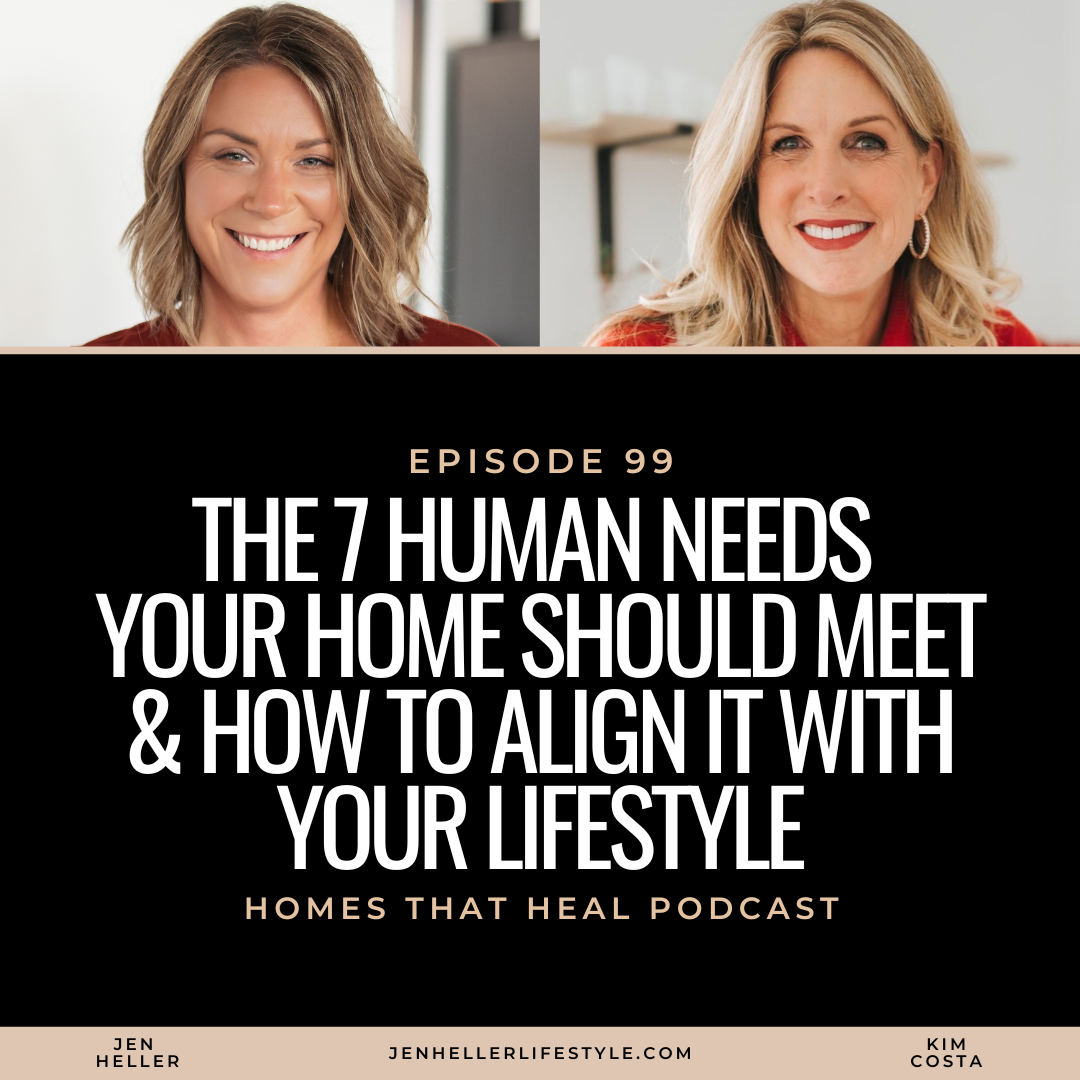
That’s exactly what Episode 99 digs into with Kim Costa, a Top 5% Realtor® and creator of The Wheel House Method. With three decades in residential construction and real estate, Kim’s take on home buying goes a lot deeper than square footage. She breaks down the 7 human needs rooted in Maslow’s Hierarchy that every home environment should be supporting. And once you hear this framework, you’ll never look at your space the same way again.
Meet Kim Costa
Kim Costa is a Top 5% Realtor®, builder, and creator of The Wheel House Method. After thirty years in residential construction and real estate, she came to a realization that changed everything: our homes don’t just shelter us, they shape us. They affect our mental clarity, physical energy, relationships, and sense of purpose. Her mission is helping people transform their home environments from sources of stress into sanctuaries of healing, growth, and intentional living, because the healthiest life starts with a home that actually supports it.
Why Your Home Environment Matters More Than You Think
Here’s a stat you might not be ready for: the United States is one of the wealthiest countries in the world, and yet our happiness ranking, especially among young people, sits at 69th globally. Sixty-ninth.
Our home environments are a big piece of that puzzle. We’ve optimized our diets, our workouts, our morning routines, but we haven’t stopped to ask whether the space we come home to every single day is actually set up to support our health and happiness. Lack of connection, constant overstimulation, no real downtime—a lot of that starts at home. And a lot of it can be addressed there too.
The good news? You don’t need a renovation. You need a framework.
The 7 Human Needs Your Home Should Be Supporting
Think of it like the house itself: the foundation has to be solid before you worry about the paint color in the dining room. These 7 needs, rooted in Maslow’s Hierarchy, work the same way. Start at the bottom and build up.
1. Physiological Needs: The Foundation of a Healthy Home Environment
Sleep, clean water, nourishment, and basic comfort. These are the non-negotiables, and your home environment either supports them or undermines them in ways you might not even realize.
Is there a busy road outside your bedroom window that’s wrecking your sleep? A water source you haven’t tested? A neighborhood with no easy access to fresh food? These aren’t small things. If your physiological needs aren’t being met, everything else on this list is harder to get to. Proximity to clean water and fresh, local food is worth factoring into where you live, not just what you eat.
2. Safety and Security
Safety goes beyond locks on the doors, though that matters too. It also means: can you age in place here if you need to? Is the neighborhood one where you feel at ease? Is there someone in your home or immediate surroundings that makes you feel unsafe?
Mobility is worth thinking about too. A primary bedroom upstairs sounds lovely until a fall or injury makes those stairs a genuine hazard. Safety, in a truly healthy home environment, means thinking a few chapters ahead. And it looks different for everyone—some people feel safest with neighbors close by; others need space and distance to exhale. Neither is wrong.
3. Love and Belonging: Making Space for Everyone
Every personality under your roof deserves a space where they feel seen. The creative kid who needs a corner for projects. The introvert who needs somewhere quiet to decompress. The couple who needs a shared gathering space that actually invites them to put the phones down and connect.
Love and belonging in a home means accepting how the people in it are made, and then designing around that, even if it just means a closet shelf for the “organized chaos” person so the dining table stays clear for dinner. It also means creating spaces for memory-making—a front porch, a gathering room, somewhere that feels less like a showroom and more like a place where life actually happens.
4. Esteem: Does Your Home Reflect Who You Are?
When you pull into your driveway, do you feel proud? When guests walk in, do they say this is so you? Or does it feel like a space that just… happened to you?
A beautiful home that doesn’t match your personality is still a misaligned home environment. Grand columns and leopard print carpet might be perfect for someone—just not for everyone. Your home should feel like an expression of your identity, not a trending aesthetic you talked yourself into because it was the only option in the right school district. If you’ve ever walked into someone’s house and immediately thought this is so them, that’s what we’re going for.
5. Cognitive Needs: Space to Think, Learn, and Grow
This one doesn’t get talked about enough. Does your home environment support focus and mental clarity? Is there a space, even a small one, where you can read, learn, create, or think without constant interruption?
Home offices, reading nooks, and dedicated workspace aren’t luxuries. They’re genuine cognitive needs. When a physical space signals this is where I focus, the mind follows. The environment creates the container—and without it, everything bleeds together.
6. Aesthetic Needs: The Cherry on Top
Aesthetics matter. But they’re the cherry on top, not the sundae. A beautiful room that doesn’t meet your lower-level needs isn’t actually serving you.
That said, when the foundation is solid, aesthetics do real work. Bring in the colors that actually suit you. Display the things collected from travels instead of boxing them up. Lean into biophilic design by bringing plants and natural textures inside—there’s research behind why that makes a space feel better. The goal isn’t a perfectly decorated room. It’s a room that feels genuinely yours.
7. Self-Actualization: The Attic of the House
This is the top floor, and it’s where the Homes That Heal mission lives. Self-actualization is the point where your home environment fully expresses and supports who you are. Different rooms for different parts of you. A wellness space for the version of you that needs to decompress. A creative corner for the version of you that needs to make things. A gathering space for the version of you that loves to host.
When someone walks into your home and immediately thinks obviously this person lives here, that’s self-actualization. The space speaks for itself. It’s not about having the most or the best—it’s about having what’s actually aligned with the life you’re living.
Where to Start When You Feel Overwhelmed
If you’re nodding along but not sure where to begin, the Lifestyle Lift Assessment at lifestylefoundations.com is a practical ten-minute walkthrough you can print out, take through your home, and use to evaluate one area of the Wheel of Life at a time. You can’t unsee what you write down, and that’s kind of the whole point.
The goal isn’t a full renovation. It’s a lift. One area, one intention, one small shift toward a home environment that actually supports the life you’re trying to live.
Someday isn’t guaranteed. Start where you are, with what you have, and move in that direction.
About Kim Costa
Kim Costa is the author of Live in Your Wheel House, creator of The Wheel House Method, and a Top 5% Realtor® serving North Atlanta. After years of living a life that looked right on the outside but felt off within, Kim rebuilt everything around alignment, intentional living, and the question of whether home and life still fit who she is becoming. Today, through her book, podcast, workshops, and real estate practice, she helps women navigate life transitions with more clarity, purpose, and intention.
Connect with Kim Costa:
- Website: www.lifestylefoundations.com
- Facebook: https://www.facebook.com/kimecostarealtor
- Instagram: https://www.instagram.com/kim.e.costa
- LinkedIn: https://www.linkedin.com/kimecosta/
Resources
- Take a peek at my Jen Recommends list to see more of my favorite products.
- Grab my FREE Home Wellness Checklist here for more tips.
Be the first to know about my new favorite wellness tools, special deals, and more, subscribe to our newsletter
Disclaimer: This podcast is for general information purposes only and does not constitute the practice of medicine, nursing, or other professional health care services. The statements and views expressed are not medical advice and are not meant to replace the advice of your medical doctor. This podcast, including Jen Heller and her guests, disclaims any responsibility and any adverse effects you may experience from the specific use of the information contained herein. The opinions of guests are their own and this podcast does not endorse or accept responsibility for the statements made by guests. The content of this podcast is not intended to be a substitute for professional medical advice, diagnosis, or treatment. If you think you have a medical condition, consult your licensed physician.


