
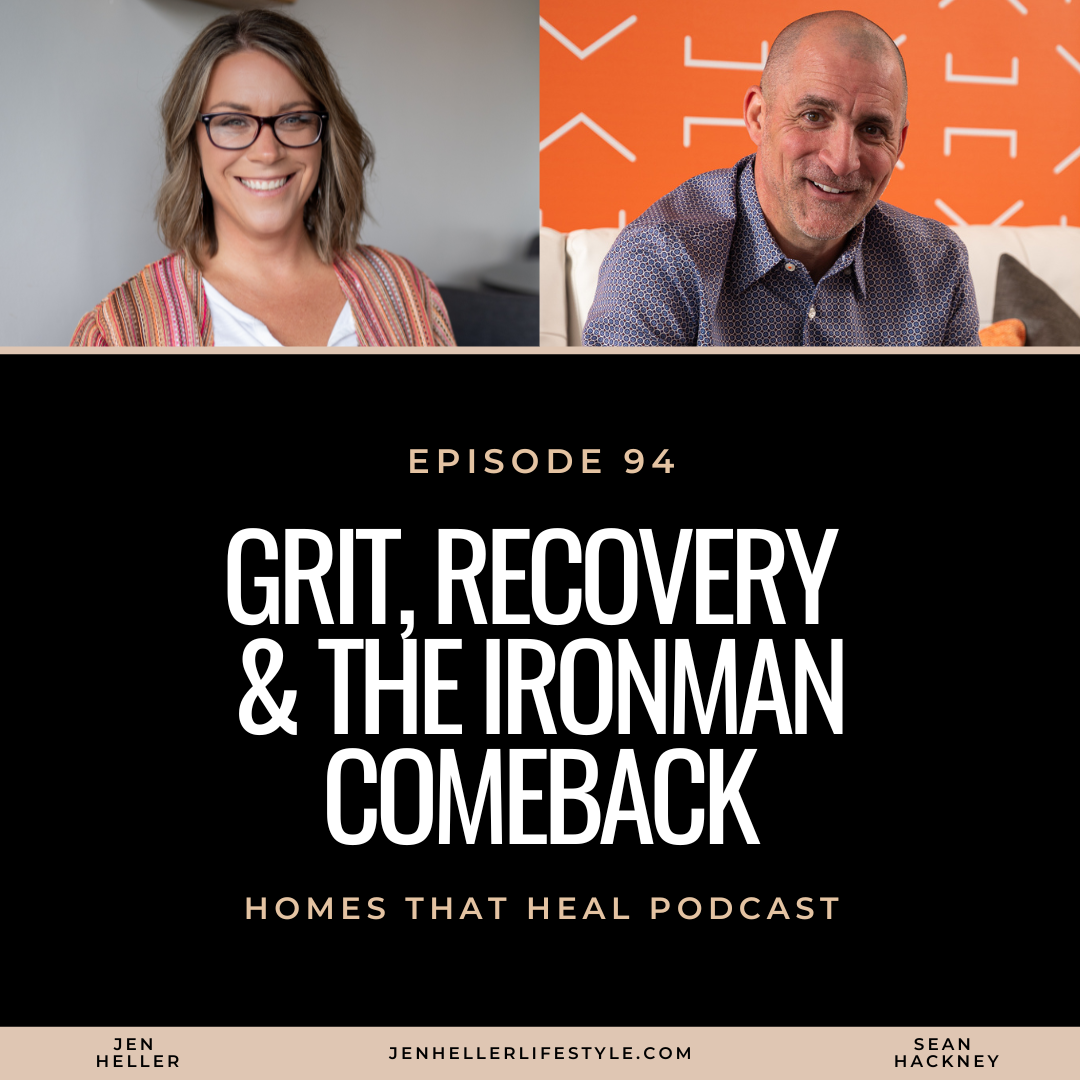
Grit, Recovery & the Ironman Comeback: A Story of Resilience with Sean Hackney
March 31, 2026
Some people talk about grit like it’s a personality trait you’re either born with or you’re not. Sean Hackney’s story of resilience after a sports injury proves otherwise — not with a lecture, but through 11 completed Ironman triathlons, 13 surgeries, and a journey that begins with a devastating knee injury on a football field in Bellingham, Washington and winds its way through vascular surgery, grief, and a finish line in Oregon.
In Episode 94 of Homes That Heal, I sat down with Sean to talk about what it actually looks like to rebuild yourself — not once, but over and over again — and how the wellness tools you bring into your home can be the very things that keep you in the game.
When Everything Changes in a Single Play: Resilience Begins Here
Sean Hackney grew up in a small town in Oregon, the kind of kid who made up for his size with effort. That grit earned him a spot on the football team at Western Washington University, and by his redshirt freshman year, he was competing for a starting position. Then, during a scrimmage just one week before the season opener, everything changed.
A two-hit collision left Sean with a dislocated kneecap, a torn ACL, nerve damage, and a nearly severed artery behind his knee. He was 19 years old. The surgeons couldn’t find a pulse in his leg. He signed paperwork giving them permission to amputate if necessary, then went into two back-to-back six-hour surgeries.
“I have no medical explanation why you have your leg,” his doctor told him afterward.
Sean’s first question coming out of surgery? What’s it going to take to play again?
That’s the kind of person we’re dealing with here.
He did attempt a comeback. He had a third surgery specifically to repair the ACL so he could return to the field. But when he finally got back for spring training, something had shifted. For the first time in his athletic life, he felt nervous. And for a player whose entire game was built on mental confidence, that was the signal. He hung up his cleats and spent the next several years figuring out who he was without football.
The Pivot That Proves You Don’t Lose What You Build
What Sean did next is one of the most telling parts of his story. He became a high school football coach for six years.
When his athletic identity was stripped away, he didn’t disappear from the sport entirely. He found a way to stay in the arena, to give back what he’d been given. It was a bridge. Maybe even a bandage, as he described it. But it was also exactly right.
That’s a lesson that applies beyond football. If you’ve ever had an injury or health setback push you into a completely different lane, Sean’s pivot is worth paying attention to. Stepping into a supporting or mentoring role doesn’t mean giving up what you built — sometimes it’s exactly where your experience does the most good.
How Grief Became the Catalyst for an Ironman Journey
The real turning point came in 2003. Sean’s mom was diagnosed with breast cancer at 55. Looking for something big to give her to look forward to — something to shift the family’s focus toward possibility instead of illness — Sean walked into a running store and signed up for an Ironman Triathlon. He barely knew how to swim. He had a surgically repaired artery, a blown ACL, and zero triathlon experience.
Sean did it anyway.
His mom didn’t make it to race day. She passed before the event. Sean crossed that finish line to honor her. He hated every minute of it. Three days later, he signed up for another one.
That’s grief and grit working together in a way that’s hard to put into words, but unmistakably human.
What 11 Ironmans Teach You About Resilience
Since that first race in 2004, Sean has completed 11 full Ironmans and over 20 half Ironman events — all while managing 13 surgeries across both legs. Both ACLs are gone. He’s lost 50% of the meniscus in each knee. The vascular damage from his original injury has required ongoing intervention over the years.
And yet, here’s what his vascular surgeons keep telling him: they can’t fully explain why his leg is doing as well as it is. The running, the movement, and the consistency appear to be keeping the circulation going in ways that defy their expectations.
His body has essentially made a case for the very thing that logic might argue he shouldn’t be doing.
Sean is also quick to point out that he’s not comparing his journey to anyone else’s. His neighbor’s 5K is just as meaningful as a full Ironman. The goal isn’t the distance. It’s the target — having something on the calendar that makes the daily discipline feel purposeful. That’s what moves the needle, whether it’s a triathlon or a walk around the block.
The Wellness Routine That Keeps Him in the Game
Morning Recovery as a Non-Negotiable
Sean is up before sunrise every morning, and his routine is worth paying attention to — not because it’s elaborate, but because it’s intentional.
He starts in the dark, in silence, wearing Normatech recovery boots for 20 to 30 minutes while he has his coffee and does his morning meditation. Not as post-workout recovery, but as a way to jumpstart circulation in legs that need the help every single day. His vascular team has started asking questions about those boots, because something is clearly working.
Low-Impact Training Tools That Make It Possible
For running, he uses a Lever treadmill attachment, a more accessible version of a zero-gravity treadmill that reduces the impact load on his joints so he can keep getting the miles in without compounding the wear and tear. On good days, he drives to trails specifically chosen for their surface. He knows his body — he’s had to learn it in a way most of us haven’t — and he manages it accordingly.
Sauna Therapy as the Newest Layer
As of January 2026, Sean added an infrared sauna to his home wellness setup. He’s already exploring heat training protocols in preparation for a half Ironman in Oregon this summer, his first race back in three years. From a cardiovascular standpoint, the timing makes sense. Sauna therapy has been shown to support circulation, aid muscle recovery, and even improve endurance performance — a natural fit for someone who has spent over two decades protecting and rebuilding his vascular health.
The sauna isn’t just a recovery tool for Sean. It’s part of a larger philosophy: be proactive. Don’t wait until your body forces your hand. Bring wellness under your roof so it’s woven into your daily life — not something you chase after the fact.
Final Thoughts
If there’s one thing Sean’s story makes clear, it’s that resilience after a major injury isn’t some special superpower reserved for elite athletes. It’s built in the small moments: the weekly goals scribbled on a notepad, the decision to coach instead of walk away, the choice to sign up for a race you have absolutely no business doing because someone you love needs something to look forward to.
The pivot isn’t the failure. It never was. When life redirects you, the wisdom and drive you’ve accumulated don’t disappear, they just find a new lane. Sean’s six years of coaching, his first terrible Ironman, his early mornings in the dark with recovery boots and a cup of coffee — none of it was wasted. It was all leading somewhere.
And maybe that’s the biggest takeaway from this conversation. Your body wants to heal. Your mind wants a target. And when you bring the right tools into your home and make wellness part of your everyday life rather than something you chase after the fact, you give yourself a fighting chance — whether you’re training for an Ironman or just trying to feel like yourself again.
Sean’s comeback race is this July. We’ll be cheering him on.
About Sean Hackney
Sean Hackney is a 23-year real estate professional and co-owner of his brokerage based in Bellingham, Washington. He is an 11-time full Ironman finisher, a 20+ half Ironman competitor with one appearance at the World Championships, and a contributing author to the Amazon bestseller Next Level Your Life. Read an excerpt here.
Connect with Sean:
- Instagram: https://www.instagram.com/theseanhackney/
- LinkedIn: https://www.linkedin.com/in/seanhackney/
Resources & Links
- Take a peek at my Jen Recommends list to see more of my favorite products.
- Grab my FREE Home Wellness Checklist here for more tips.
- Learn more or shop for your own Clearlight Sauna.
Be the first to know about my new favorite wellness tools, special deals, and more, subscribe to our newsletter!
Disclaimer: This podcast is for general information purposes only and does not constitute the practice of medicine, nursing, or other professional health care services. The statements and views expressed are not medical advice and are not meant to replace the advice of your medical doctor. This podcast, including Jen Heller and her guests, disclaims any responsibility and any adverse effects you may experience from the specific use of the information contained herein. The opinions of guests are their own and this podcast does not endorse or accept responsibility for the statements made by guests. The content of this podcast is not intended to be a substitute for professional medical advice, diagnosis, or treatment. If you think you have a medical condition, consult your licensed physician.


