
When Mental Health Hits Rock Bottom: Choosing Hope, Healing, and Life
March 24, 2026
There are moments in life that split everything into before and after. For me, one of those moments was a phone call about my niece Morgan. And the best part of this story? Where she is now.
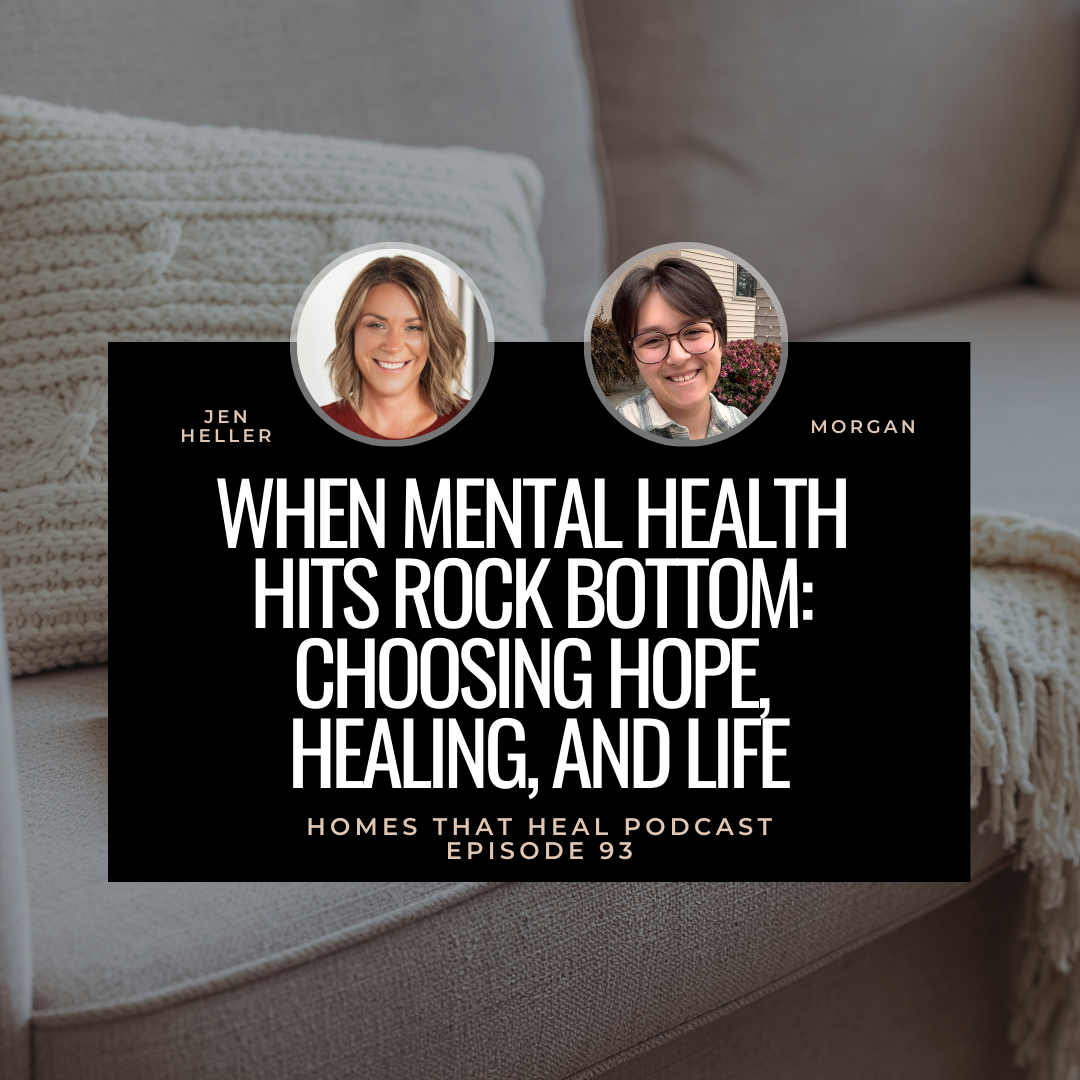
If you’ve ever loved someone through a mental health crisis — or lived through one yourself — you know that healing rarely looks the way you expect it to. It’s not linear. It’s not clean. And it almost never happens overnight. But it can happen. And this episode is proof of that. In Episode 93 of Homes That Heal, I sat down with my niece Morgan for the first ever episode of Morgan’s Corner — an honest, emotional conversation about mental health, rock bottom, and what coming back to life really looks like.
Morgan is 19 now. She’s happy, healthy, and thriving — passionate about photography, forest school teaching, and sharing love and light with the world. But a year ago, almost to the day, she was standing on a bridge over the Wisconsin River on a cold winter night, convinced there was no way forward.
This is her story. And I truly believe it’s going to help somebody.
The Night That Changed Everything
Mental health struggles don’t usually arrive all at once. For Morgan, they built slowly over years — starting around age 13 with a rocky home environment, poor sleep, a diet of gas station snacks and grab-and-go junk food, and almost no time outside in nature. Add in bullying at school, constant scrolling on social media, and a revolving door of psychiatric medications that left her feeling disconnected from her own body, and you start to understand how a smart, sensitive, deeply perceptive young woman could find herself in a very dark place.
By the time Morgan was 18 — living alone, working full-time, and trying to finish her senior year of high school all at once — the weight of it had become unbearable.
The night she ended up on that bridge, her furnace had gone out. She’d spent the day quietly saying goodbye, surrendering her cat to a shelter, and driving around trying to figure out a way out. She walked down to the riverbank. She put her feet in the water. And then something — she still isn’t quite sure what — turned her around and walked her two blocks to the police station instead, where she picked up a phone and said the bravest words she’d ever spoken: I need help.
I got the call the next morning from my mom. And I remember fighting back tears and my throat closing as she told me the story.
What Nobody Tells You About Teen Mental Health
One of the most important things Morgan and I talked about in this episode is what was actually going on underneath the crisis — because the bridge wasn’t the beginning. It was the culmination of years of unmet needs that nobody had quite connected the dots on.
Environment matters more than we think
Morgan grew up in a chaotic, unstable home environment — loud, cluttered, unpredictable. And as she said herself, for any teenager that’s hard. For a teenager already struggling with their mental health, it’s a recipe for disaster. Her nervous system was in a constant state of fight-or-flight, and there was nowhere safe to land.
When she eventually moved into what we call Heller Haven — our home in the woods outside Madison, WI — one of the first things she noticed was the quiet. The cleanliness. The fact that she had her own room, her own bed, and people who sat down to eat dinner together. It sounds simple. But for Morgan, it was completely foreign. And it was the foundation everything else was built on.
Social media and teen mental health are deeply tangled
Morgan was honest about this in a way I really respect. She spent years on her phone, finding community and connection in online spaces because real-world connection felt too hard or too painful. And while she found people who understood her, she also found herself going deeper and deeper into an isolated, inward spiral — identifying with more and more labels, absorbing more and more content that confirmed how broken she felt, and losing touch with the actual people around her.
She wasn’t going outside, and she wasn’t moving her body. She wasn’t getting sunlight or fresh air or the kind of grounding that nature provides. And her mental health reflected all of it.
Medications can mask the root cause
This is a conversation we’ll go deeper on in a future episode of Morgan’s Corner, but it’s worth naming here. By the time Morgan came to live with us, she was on a cocktail of psychiatric medications that had been adjusted, layered, and rotated since she was 13 years old. And one of the things she kept telling me was that she didn’t feel like she was in her own body.
That was important information. Because you can’t do the deep healing work — the emotional work, the identity work, the trauma work — if you’re not actually present inside yourself. Getting Morgan off those medications slowly and safely, with proper support, was one of the first things we worked on. And the difference it made was significant.
What Healing Actually Looked Like
When Morgan moved in, we didn’t have a 12-step plan. What we had was love, a safe space, and a deep commitment to getting to the root of things rather than just managing the symptoms.
Here’s what that looked like in practice.
We started with the basics — real food, regular meals, clean water, and sleep. Morgan had been living on processed snacks and irregular eating patterns for years. Her body was starving for nourishment in every sense of the word. We ate breakfast, lunch, and dinner together. We cooked real food. And slowly, her body started to respond.
We got her outside every single day. I probably told her a thousand times: go lay in the grass and come back and tell me how you feel. Nature is not a nice-to-have when it comes to mental health support. It’s fundamental. The grounding, the sunlight, the quiet, the reconnection with something bigger than the noise inside your head — it matters enormously.
We brought in the right support. I’m lucky to have spent 15 years in the wellness world and to have incredible friends and practitioners in every corner of the country. Morgan worked with our dear friend, Carey, on hypnosis therapy and trauma processing. We did nutritional testing with Alex, dialing into supplements and deficiencies, then supported her body at a foundational level. We peeled back the layers slowly, with care.
And through all of it, we kept the conversation open. No judgment. No punishment. Just curiosity, love, and a lot of questions. Morgan told me that one of the things that helped her most was knowing she could tell me anything and be met with neutrality instead of anger. That safety — that psychological safety — was everything.
It wasn’t a straight line. There were hard days, meltdowns, and moments where I tested my own limits in ways I didn’t know were possible. But we kept showing up for each other.
The Road Trip to South Dakota
About a few months into her time with us, Morgan ran. Literally — she packed a bag, got in her car with her graduation money, changed her clothes in a Target parking lot, and drove to South Dakota.
I didn’t realize she was gone until Mark asked where she was for dinner.
There’s a lot more to that story — including the police, her dad’s seven-second voicemail that broke through everything, and the moment she came home and was met with a hug instead of a lecture. But the short version is this: she came back. And that was the turning point. The moment we both knew this wasn’t just a temporary situation. This was home.
Morgan’s Message for Anyone Who Is Struggling
Near the end of our conversation, Morgan read something she had written — and I have to tell you, this kid is a writer. She’s always got a journal nearby.
Her message wasn’t the usual be strong, be brave. She said those words never meant much to her when she was in the thick of it, because she didn’t feel strong or brave. What she asked for instead was simpler and more honest: have courage.
Not bravery. Courage — which she defined as moving forward despite being afraid. Having the courage to put the negative thoughts in their place. To tell yourself I will get through this even when you don’t believe it yet. To have hard conversations, face hard days, and keep going anyway.
She wrote: “Your thoughts, your intentions are the most powerful force that you have. If you tell yourself you will have courage today and you will get through this — you will.”
I’ve said it before and I’ll say it again. This kid is going to write a book someday. And I can’t wait to read it.
What This Episode Is Really About
At its core, this conversation about mental health is about something this show has always been about — the profound connection between our environment, our relationships, and our ability to heal.
Morgan didn’t get better because she was given the right medication or the right diagnosis. She got better because she was given a safe place to sleep, healthy food to eat, time in nature, people who loved her without conditions, and the space to do the deep, slow, layered work of coming back to herself.
That’s what a home that heals actually looks like. Not perfect. Not fancy. Just safe, nourishing, and full of love.
Morgan’s story isn’t over — it’s just getting started. And we’ll keep having these conversations right here on Morgan’s Corner.
Morgan’s Bio
Morgan Lee is a happy, healthy, thriving young woman whose interests are photography, forest school teaching, and sharing love and light with the world.
Resources & Links
- If you or someone you love is struggling with mental health, help is available 24/7 — call or text 988 to reach the Suicide & Crisis Lifeline.
- Take a peek at my Jen Recommends list to see more of my favorite products.
- Grab my FREE Home Wellness Checklist here for more tips.
Be the first to know about my new favorite wellness tools, special deals, and more, subscribe to our newsletter!
Disclaimer: This podcast is for general information purposes only and does not constitute the practice of medicine, nursing, or other professional health care services. The statements and views expressed are not medical advice and are not meant to replace the advice of your medical doctor. This podcast, including Jen Heller and her guests, disclaims any responsibility and any adverse effects you may experience from the specific use of the information contained herein. The opinions of guests are their own and this podcast does not endorse or accept responsibility for the statements made by guests. The content of this podcast is not intended to be a substitute for professional medical advice, diagnosis, or treatment. If you think you have a medical condition, consult your licensed physician.


