
Why Yoga Is More Than Movement
February 3, 2026
Most of us don’t wake up thinking, “Wow, my nervous system feels really balanced today.” We wake up thinking about deadlines, kids, emails, laundry, the state of the world, and whether we remembered to move the chicken from the freezer. But underneath all of that noise is something far more foundational—how safe our bodies feel moving through the day. That’s why yoga isn’t just about twisting yourself into a pretzel or mastering handstands; it’s about learning how to come back to yourself when life keeps pulling you outward. We often hear about the ‘yoga bubble,’ but the true magic happens when we use yoga for nervous system regulation.
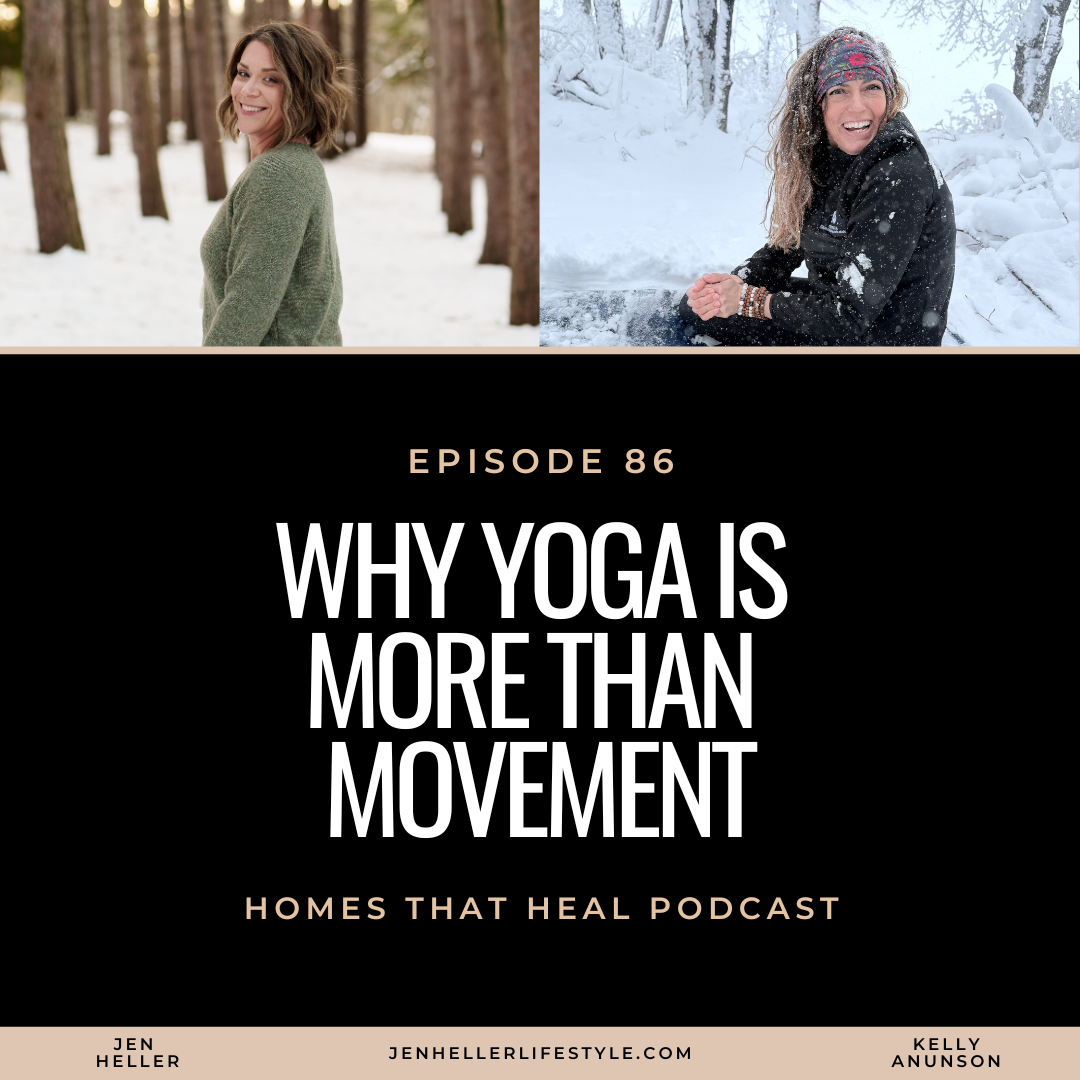
In this episode of Homes That Heal, I sat down with my dear friend and yoga instructor Kelly Anunson for a conversation that went far beyond the mat. We talked about what yoga really is (and what it isn’t), why so many people feel intimidated by it, and how a consistent, compassionate practice can help regulate the nervous system in ways that ripple into every part of life.
This blog is an invitation to slow down, breathe a little deeper, and reconsider yoga—not as exercise, but as a way of living.
Meet Kelly Anunson: A Guide Back to Balance
Kelly Anunson is the kind of teacher whose presence alone makes your shoulders drop an inch. She’s grounded, honest, deeply compassionate, and refreshingly real about what it means to practice yoga in a busy, modern life.
Her journey into yoga didn’t start with enlightenment—it started with a VHS tape (Rodney Yee, for those who remember). Like many of us, she originally came to yoga for movement and exercise. But something shifted when she stepped into a studio for the first time and felt a connection that went far deeper than her muscles.
Years later, after a full career, journaling dreams she had forgotten, and trusting what she describes as divine timing, Kelly opened her own yoga studio. Today, she teaches yoga, meditation, and therapeutic work with a focus on trauma, self-study, and balance—not perfection.
She doesn’t just teach this work. She lives it.
Why So Many of Us Are Dysregulated (and Don’t Even Know It)
We talk a lot about stress, but we rarely talk about regulation.
Many people are living in a constant state of low-grade fight-or-flight. Not because something terrible is happening in this moment, but because the body has learned to stay alert just in case. Deadlines, notifications, chronic busyness, emotional labor, unresolved trauma—all of it trains the nervous system to stay on guard.
Over time, that shows up as:
- Anxiety or irritability
- Trouble sleeping or feeling “tired but wired”
- Difficulty focusing
- Chronic tension or pain
- Emotional reactivity
- Feeling disconnected from your body
This isn’t a personal failure. It’s a biological response.
And this is where yoga—real yoga—becomes powerful.
Yoga for Nervous System Regulation Is Not What You Think
One of the biggest myths Kelly busts in this episode is the idea that yoga is just movement.
Yes, there is a physical component (asana), but that’s only one part of an eight-limbed system. Yoga predates religion. It wasn’t created to make people flexible or calm-looking. It was created as a path toward self-realization—toward understanding yourself more clearly.
The physical postures were designed to prepare the body to sit in stillness. To breathe, meditate, and pay attention.
In other words, yoga isn’t about doing more.
It’s about learning how to be.
The Nervous System and the Power of the Pause
Kelly explains something beautifully simple: what we practice on the mat is what we practice in life.
When you’re standing in tree pose and start to wobble, your instinct might be to tense up or rush. But yoga invites something different—find a focal point (drishti), return to the breath, soften, and respond instead of react.
That same pattern applies off the mat.
When life throws a challenge your way—a difficult conversation, a stressful workday, a sick child—most of us go straight into reactivity. We skip the pause. That’s when words come out wrong, decisions feel rushed, and regret sneaks in later.
Yoga teaches the nervous system that there is another option.
Pause. Breathe. Choose.
This is nervous system regulation in real time.
On the Mat vs. Off the Mat: Why Both Matter
During our conversation, we talked about the importance of physical spaces—why Kelly chose to open a brick-and-mortar studio instead of teaching exclusively online.
While online classes absolutely have value, there’s something powerful about stepping away from your to-do list, your phone, your laundry, and entering a space designed to hold you.
A yoga studio becomes a container.
A place where your nervous system can exhale because it doesn’t have to be “on” for anyone else.
That said, yoga doesn’t stay in the studio. The real work happens when you take what you practice—breath, focus, compassion—back into your relationships, your parenting, your work, and your inner dialogue.
Yoga Is Not a Religion (and Other Myths Worth Letting Go)
If yoga feels intimidating, you’re not alone. Kelly hears the same concerns over and over:
- “I’m not flexible enough.”
- “I can’t slow my mind down.”
- “I don’t look like a yogi.”
- “Yoga is a religion.”
- “Everyone there will be calmer than me.”
Let’s clear a few things up.
Yoga is not a religion. It can be spiritual, but it doesn’t ask you to worship anything. It asks you to pay attention. You don’t need to be flexible, have a cute matching outfit (but it’s OK if you do), nor be a zen master. You come to yoga to become more connected—not to perform. Yoga is for people who feel chaotic, overwhelmed, and human.
Kelly says it best: “It’s yoga practice, not yoga perfect.”
The Role of Self-Study (Svadhyaya) in Healing
One of the most powerful concepts Kelly shares is svadhyaya, or self-study.
This isn’t self-criticism. It’s curiosity.
Yoga invites you to notice:
- How you respond when things feel hard
- Where you hold tension
- When you push instead of soften
- How you talk to yourself
Over time, this awareness becomes a mirror. Not to judge yourself—but to understand how you want to show up in your life.
Self-study is how regulation becomes sustainable.
Why Yoga Supports Healing Beyond the Body
When the nervous system feels safer, everything else works better.
People often come to yoga for physical reasons—tight hips, sore backs, stress relief. But what keeps them coming back is how it changes their relationship with themselves.
As Kelly shared, when she truly integrated yoga as a way of life—not just an hour-long class—the shift didn’t just affect her. It affected her family, her relationships, and her sense of purpose.
What we regulate internally gets magnified externally.
That’s not poetic fluff. It’s biology.
A Personal Note: Choosing the Mat When Life Feels Full
I shared on the episode how, on my birthday, I almost skipped yoga. My mind told me I should be in my office, catching up, being productive. But something deeper said, Go.
That class reminded me—again—that I had nowhere else to be but in my body.
I cried in savasana. Not from sadness, but from gratitude. From the simple relief of being present.
That’s what this practice offers when we let it.
You Don’t Have to Do This Perfectly
Kelly works with people healing from trauma, burnout, and deeply ingrained patterns of shame. One thing she sees over and over is how quickly people turn healing into another performance metric.
Yoga is not another thing to fail at.
It meets you exactly where you are.
Some days that looks like strength and balance. Other days it looks like lying on the mat and breathing. Both count.
Consistency matters more than intensity.
Practical Ways to Begin (or Begin Again)
If yoga feels intimidating, here’s a gentle starting point:
- Start with breath awareness. No poses required.
- Choose a beginner-friendly or restorative class.
- Let go of comparison—everyone is in their own bubble.
- Focus on how you feel, not how you look.
- Show up imperfectly and consistently.
Yoga for nervous system regulation doesn’t demand anything from you. It offers support.
The Bigger Picture: Creating a Life That Feels Balanced
One of the most hopeful parts of this conversation was Kelly’s belief that balance is possible for everyone—even busy parents, business owners, and people who feel stretched thin.
Not through willpower. Through compassion.
Through small, accessible practices that help unwind subconscious patterns and bring the body out of survival mode.
This is the heart of yoga. And it’s why this practice has lasted thousands of years.
Final Thoughts: Coming Back to Yourself
Yoga doesn’t ask you to become someone new.
It asks you to remember who you are underneath the noise.
If your body has been asking for more gentleness, more presence, and more space to breathe, this episode—and this practice—might be exactly what you need right now.
Meet Kelly Anunson
Kelly Anunson, (B.S., M.S.) is a truth-seeker, follows her dreams, and desires to share her vibrant energy with others. She is a Reiki Master practitioner, Compassionate Inquiry Practitioner, and Certified Yoga Alliance instructor. Her earlier professional experience includes 15 years of service in the educational field as an instructor and in student services. .Kelly is passionate about healing the whole body — mind, body, and spirit. She understands that a sacred space inside the being is essential in order for the journey to health to take place. Her intention is to lift others up so that they can experience a joy-filled life.
Embrace started as a vision for creating a space for each individual to access guidance on how to live a meaningful and purposeful life. Kelly weaves together tools and techniques to meet each person on their unique journey. Offering energy healing, daily practices, and spaciousness for inner discovery through mindfulness, meditation, yoga, and Compassionate Coaching. Embrace is a destination of authentic discovery to help each person navigate the complexities of our inner landscape and outer world. Bringing compassion, connection, and courage into our mind, body, and spirit we can Embrace each breath, each moment, each day with loving awareness.
Connect with Kelly:
- Website: www.embracethejourney.studio
- Facebook: https://www.facebook.com/embracethejourney.studio
- Instagram: https://www.instagram.com/embracethejourney.studio
Resources & Links
- Take a peek at my Jen Recommends list to see more of my favorite products.
- Grab my FREE Home Wellness Checklist here for more tips.
Be the first to know about my new favorite wellness tools, special deals, and more, subscribe to our newsletter!
Disclaimer: This podcast is for general information purposes only and does not constitute the practice of medicine, nursing, or other professional health care services. The statements and views expressed are not medical advice and are not meant to replace the advice of your medical doctor. This podcast, including Jen Heller and her guests, disclaims any responsibility and any adverse effects you may experience from the specific use of the information contained herein. The opinions of guests are their own and this podcast does not endorse or accept responsibility for the statements made by guests. The content of this podcast is not intended to be a substitute for professional medical advice, diagnosis, or treatment. If you think you have a medical condition, consult your licensed physician.


