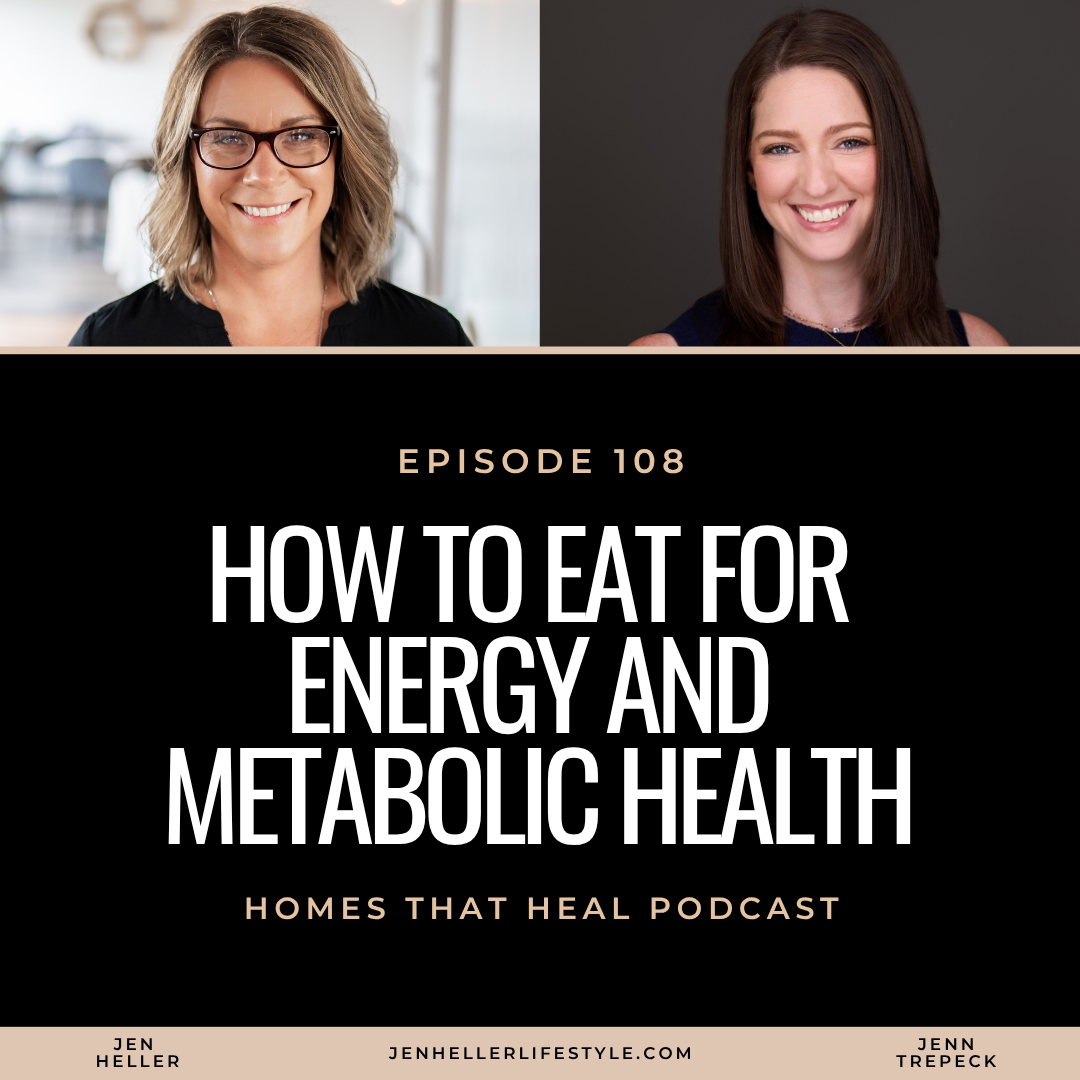
If you’ve ever done “everything right” and still felt exhausted by noon, you’re not alone and you’re probably not imagining it either. Most of us are swimming in wellness information but starving for answers that make sense. That’s where eating for metabolic health comes in. Not as another diet. Not as a supplement stack, but as a way of understanding how your body works and feeding it accordingly.
In Episode 108 of Homes That Heal, I sat down with health coach, podcaster, and author Jenn Trepeck. She’s spent nearly two decades helping people cut through the noise and get back to the basics, and this conversation did not disappoint.
Meet Jenn Trepeck
Jenn grew up the skinny one in a family of dieters—which, as she puts it, was awesome until it went away. After years on the weight roller coaster, she stopped listening to diet plans and started listening to the people talking about how the human body works. That shift changed everything for her, and she’s been on a mission to share that information ever since.
She’s the host of the Salad with a Side of Fries podcast, a Health and Lifestyle Coach, and the author of Uncomplicating Wellness: Ditch the Rules. Quiet the Noise. Reclaim Your Life. Her motto? Wellness without the weirdness. You can see why I had to get her on the show.
It’s Not What You Eat—It’s How You Eat for Metabolic Health
Here’s the line from Jenn that flipped everything for me: “It’s not what to eat, it’s how to eat.”
You already know that a cucumber is a better nutritional choice than a Twix. You don’t need a nutrition degree for that. What nobody ever taught us is how to eat in a way that supports energy, metabolic health, cardiovascular health, and cognitive clarity.
The Protein and Fiber Framework
Jenn has a mantra she teaches every single client, and I love it:
“Protein and fiber at every meal makes removing fat no big deal.”
Here’s what that looks like:
- Protein means clean, lean protein—eat what you like, skip what you don’t. For a biologically female body, a serving at a meal is four to six ounces (think: your whole hand). At a snack, it’s about two to three ounces (your palm). For a biologically male body, bump that up to six to eight ounces at a meal.
- Fiber means vegetables and sometimes fruit. Eight to twelve servings of vegetables a day, where a serving is roughly a handful (two handfuls for leafy greens like spinach or arugula). That sounds like a lot, but when you start building the habit, it becomes second nature.
- Quality fat is the third piece: avocado, nuts, seeds, and quality oils. A serving of avocado, by the way, is half an avocado. Jenn’s words, not mine, but I appreciated the reminder.
The only difference between a meal and a snack is how much you have and how long it’ll hold you. Keep it that simple.
Blood Sugar Balance and Why It Matters
When you pair foods this way—protein, fiber, quality fat—you’re naturally supporting blood sugar balance. And that matters more than most people realize.
Whether it’s a Twix, the bread basket at dinner, or your dessert, Jenn’s guidance is consistent: have it with or after your quality food —not before and not instead of. That one shift can change how your body responds to foods you’ve been blaming yourself for eating for years.
Why You’re Wired but Tired (It’s Your Cortisol)
There’s the brain fog, the afternoon crashes, the lying awake at midnight, wondering why you’re exhausted all day but can’t sleep. Sound familiar?
If you’re a woman in your forties, you’ve probably been told it’s just perimenopause. Maybe handed a pamphlet and sent on your way. But here’s what often gets missed: the adrenal glands are part of the HPA axis—the same system that regulates your sex hormones. So when your adrenals are struggling, your whole hormonal picture feels it. The brain fog, the exhaustion, the wired-but-tired pattern—stress and adrenal fatigue are often a key piece of what’s driving those symptoms. It’s not either/or. It’s all connected.
And a lot of it comes back to your cortisol curve. It’s supposed to rise in the morning to wake you up, then drop off steadily throughout the day. But for most women dealing with adrenal fatigue, it’s all over the place. And one of the biggest things making it worse? Caffeine before food.
The Coffee-Before-Breakfast Problem
I know. I know. But hear Jenn out on this one, because she makes it not as dramatic as it sounds.
When you reach for caffeine before eating, you’re throwing off your body’s natural cortisol rhythm—the very thing that’s supposed to give you energy in the morning. The fix isn’t to quit coffee. It’s just to eat first. Have a proper meal—protein, fiber, quality fat—within an hour to ninety minutes of waking up. Then have your coffee with or after food, not before. And ideally, wrap up caffeine by noon or one o’clock depending on your bedtime.
That’s it. One shift. See what you notice.
The Bullseye of Change: A Framework for Making Healthy Eating Habits Stick
Knowing what to do is only half the equation. The other half is doing it consistently when life keeps changing around you.
Enter the Bullseye of Change.
How the Bullseye of Change Works
Draw three concentric circles—like a target. Here’s what each ring means:
- The outermost ring is your behaviors. Things you do. Individual actions, repeated over time.
- Behaviors that repeat become habits. That’s the middle ring.
- The collection of your habits creates your identity. That’s the bullseye—the center.
Then there’s one more ring to draw—all the way on the outside. That’s your environment. And this is where things get really relevant for those of us who are intentional about creating a home that heals.
Why Metabolic Health Habits Fall Apart (And How to Fix It)
Most people try to change their identity first. They say “I need to be a healthy person”—and then beat themselves up when they fall short. Jenn flips that approach entirely.
Start with the behaviors. Small, specific, almost embarrassingly simple ones. Want to be someone who moves after dinner? Eat dinner with your sneakers already on. Want to eat more protein? Go to the fridge before the pantry every time you’re hungry. Want to build a morning routine that supports your energy? Eat before you touch the coffee maker.
Those tiny behaviors, repeated, become habits. Those habits, stacked, build an identity. And when your environment changes — a new job, travel, a move—you don’t lose who you are. You just revisit the outer rings and adjust the behaviors. The identity stays intact.
Jenn put it beautifully: it’s less like a light switch and more like a jellyfish—pulsing in and out, adjusting as you go. That’s not failure. That’s just how change works.
The Bottom Line on Eating for Metabolic Health
Only 12% of the U.S. population is metabolically well. Read that again. That means the other 88% of us are starting from a place where the basics matter far more than any biohack ever could.
A cold plunge and supplements are great—when the foundation is in place. But if you’re running on caffeine, skipping protein, and crashing at three in the afternoon, the biohacks aren’t going to move the needle. The bio stack comes first. And the bio stack is simpler than you think.
Food. Protein. Fiber. Quality fat. Eat before you caffeinate. Build the behaviors that support the identity you want. Let your environment—starting with your kitchen—work for you instead of against you.
That’s eating for metabolic health. And Jenn makes it feel doable.
About Jenn Trepeck
Jenn Trepeck has been described as a “force of nature” in the wellness space. She is a Health and Lifestyle Coach, Podcaster, and Consultant who grew up the skinny one in a family of dieters—which was awesome until it wasn’t. After years on the weight roller coaster and trying every diet under the sun, Jenn learned the nutrition education we’re all supposed to know, but nobody ever taught us. That changed her life, and from then on she set out to pay it forward.
After over a decade of working one-on-one with clients, Jenn launched the Salad with a Side of Fries podcast—science-based, yet lighthearted. Her debut book, Uncomplicating Wellness: Ditch the Rules. Quiet the Noise. Reclaim Your Life. (October 2025), offers a practical approach to cutting through the wellness noise and finally trusting your body again. Recognition includes Podcast Magazine’s 40 under 40, a 2022 International Women’s Podcast Award nomination for Visionary Leadership, the 2025 Women Who Podcast Award for Stellar Interview, and Ear Worthy’s Best Health Podcast for both 2024 and 2025. Her motto: wellness without the weirdness.
Connect with Jenn:
- Website: https://asaladwithasideoffries.com
- Free Guide — “It’s Not What to Eat, It’s How to Eat”: https://asaladwithasideoffries.com
- Book — Uncomplicating Wellness: https://amzn.to/4dGfkfX
- Book a free 15-minute call: https://asaladwithasideoffries.com/contact
- Instagram (personal): https://www.instagram.com/jenntrepeck
- Instagram (podcast): https://www.instagram.com/saladwithasideoffriespod
- Facebook: https://www.facebook.com/Saladwithasideoffriespodcast
- YouTube: https://www.youtube.com/@jenntrepeck
- TikTok: https://www.tiktok.com/@jenntrepeck
- LinkedIn: https://www.linkedin.com/in/jennifertrepeck
- X/Twitter: https://x.com/jenntrepeck
Resources
- Take a peek at my Jen Recommends list to see more of my favorite products.
- Grab my FREE Home Wellness Checklist here for more tips.
- The newsletter is where I get a little more personal. If you’re not on the list yet, come join us.
- Join the Jen Heller Collective Waitlist
Disclaimer: This podcast is for general information purposes only and does not constitute the practice of medicine, nursing, or other professional health care services. The statements and views expressed are not medical advice and are not meant to replace the advice of your medical doctor. This podcast, including Jen Heller and her guests, disclaims any responsibility and any adverse effects you may experience from the specific use of the information contained herein. The opinions of guests are their own and this podcast does not endorse or accept responsibility for the statements made by guests. The content of this podcast is not intended to be a substitute for professional medical advice, diagnosis, or treatment. If you think you have a medical condition, consult your licensed physician.


