
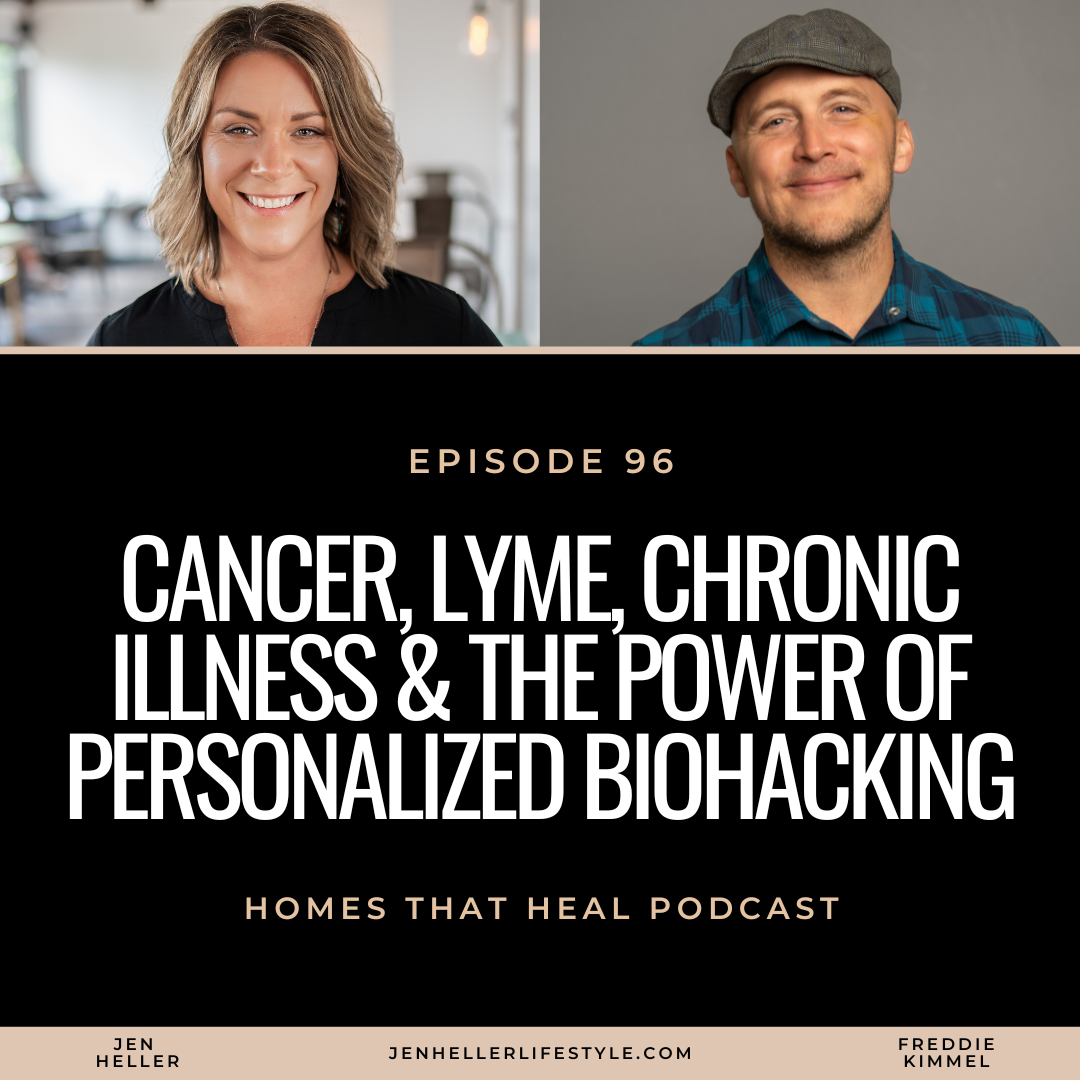
Cancer, Lyme Disease, Chronic Illness and the Power of Personalized Biohacking
April 14, 2026
There’s a particular kind of exhaustion that comes from doing everything the medical system tells you to do and still feeling like you’re losing. You follow the protocol and take the medications. You show up for every appointment. And yet you’re still sick. If you’ve been there, you know. Freddie Kimmel has been there too, and in Episode 96, he walks us through his winding road of recovery from chronic illness, cancer, and Lyme disease—and the personalized biohacking tools that helped him finally turn the corner.
This one is for anyone who has ever sat in a doctor’s office and thought: there has to be more to this story.
Meet Freddie Kimmel: From Broadway Stages to Biohacking Pioneer
Freddie Kimmel didn’t set out to become a wellness educator. He set out to be a Broadway performer. And for a while, he was doing exactly that; booking shows, building a career, living the dream in New York City.
Then his body started sending signals he couldn’t ignore.
Joint pain so severe he couldn’t close his hands. A cancer diagnosis at 26 that had already metastasized to nine tumors surrounding a kidney, his lymph nodes, and the vena cava leading to his heart. Four brutal rounds of chemotherapy. Multiple surgeries, including one that cut him sternum to pelvis. And then, when the cancer was finally gone, a new nightmare: Lyme disease, chronic fatigue syndrome, heavy metal toxicity, scar tissue obstructions, and a body that simply refused to cooperate.
He was in his late twenties, broke, renting out rooms on Airbnb to fund experimental treatments, and holding his own shoelaces wondering what came next.
Today, Freddie is a certified health coach, wellness technology consultant, host of the Beautifully Broken Podcast, and creator of the Biological Blueprint, a 95-lesson academy built for people who are ready to stop waiting for someone to save them and start asking better questions. He works on the leadership team at AmpCoil and has made it his life’s work to be, as he puts it, “a lighthouse for those walking in my footsteps.”
Why Personalized Biohacking Isn’t a Protocol, It’s a Practice
Here’s the thing Freddie is very clear about: his story is not your roadmap.
Every treatment he tried, every tool that worked, every dead end he hit, all of it was specific to his biology, his timeline, and his body’s particular burden. What helped him is not automatically what will help you. And honestly? That’s a relief. It means you’re not doing it wrong just because someone else’s protocol didn’t pan out.
The real work of personalized biohacking for chronic illness recovery is learning to ask better questions. How do you feel? What do you want? And what are you actually willing to do about it? Freddie calls this the formula, and it’s a lot more useful than any supplement stack.
That said, there are some tools that kept coming up in his healing journey. Tools that, when used consistently and intentionally, have been shown to support the body’s natural processes in meaningful ways.
The Tools That Supported Freddie’s Recovery from Chronic Illness
PEMF Therapy and the AmpCoil: Quieting the Noise
One of Freddie’s biggest turning points came from pulsed electromagnetic field therapy, specifically through a device called AmpCoil, which combines PEMF with sound frequency therapy.
He describes the way a PEMF wave moves through the body like a breeze through a leafy tree. It doesn’t slow down for clothing, tissue, or bone. The theory is that it helps increase the charge of individual cells, supporting them in doing their work more efficiently. For Freddie, the shift wasn’t dramatic or overnight. But after about six months of consistent use, he noticed something: the bowel obstructions that had been sending him to the ER every single month had stopped.
That was enough to make him want to understand exactly why.
Infrared Sauna vs. Traditional Sauna: Know the Difference
Both Freddie and Jen are passionate about heat therapy, and they spend a good chunk of this episode breaking down why infrared and traditional saunas produce genuinely different results, especially for chronic illness and cancer recovery.
Traditional saunas heat the air around you, forcing the body to sweat. It’s ancient wisdom, totally valid, incredibly powerful. But infrared sauna uses light energy that penetrates one to two inches beneath the skin, heating the body from the inside out. For people dealing with inflammation, joint pain, poor circulation, or the aftermath of chemotherapy, that internal warmth can reach places a traditional sauna simply can’t.
Freddie notices a measurably different pain response from infrared. After all his surgeries left cold spots along his abdomen, infrared is what helps him feel evenly warmed throughout. He also tracks a clearer, calmer mental state after an infrared session, something Jen echoes from her own recovery after a stroke.
The takeaway: neither is better. They’re different tools. And the best one is the one you’ll actually use consistently.
Flowpresso Lymphatic Drainage: The One Jen Won’t Stop Talking About
If you’ve heard Jen mention the Flowpresso before, this episode is where she unpacks exactly why she’s so enthusiastic about it.
The Flowpresso is a full-body compression suit with 22 overlapping chambers that create a slow, sequential wave of pressure moving from the feet upward. It layers in gentle infrared heat and a nano vibrational chip at the base of the spine that has been associated with helping the brain shift into a theta wave state. The same relaxed, creative state children naturally inhabit.
Why does lymphatic drainage matter so much, especially in chronic illness recovery? Because you have three times as much lymphatic fluid in your body as blood, and no pump to move it. When that fluid stagnates in your tissues instead of cycling through your cells, your body’s ability to clear waste and deliver nutrients takes a hit. Flowpresso essentially gives the lymphatic system a long, slow, intentional assist.
Jen’s description after her first 10-minute session: like the best massage of her life, combined with the feeling that something had genuinely drained and shifted.
Bimini Nanobubble Oxygen Therapy: The Newest Tool in the Kit
This one is newer, and Freddie is the first to say it’s not for everyone yet, partly because of price point, partly because the research is still catching up to the technology.
But here’s the concept: an oxygen concentrator breaks oxygen down into stable nanobubbles (0.01 microns) in water. Because the bubbles are stable, they don’t evaporate. You sit in the water and absorb oxygen transdermally. Freddie, who has struggled with sleep quality for years, tracked a full week of near-perfect sleep scores after his first trial with the device. His HRV has climbed consistently since adding it to his routine.
He’s quick to note: you don’t necessarily need this specific device. What he believes in is the underlying principle that oxygen therapy, in some form, has real value in an era of chronic sympathetic nervous system dominance and sedentary lifestyles. Even intentional breathwork can move the needle.
The Big Picture: Your Body Is Not a Mr. Potato Head
Freddie puts it plainly: you are not a collection of broken parts that need to be swapped out one by one.
The body is a complex, interconnected system. Your lungs have an energetic relationship with other organ systems. The lymphatics respond to how you move and breathe. Your nervous system state affects how well any healing modality actually lands. When you’re running on fumes, cortisol, and a sympathetic nervous system in overdrive, even the best tools in the world are working against the current.
The foundation—sleep, movement, whole food, hydration, intentional breathing, honoring rest—has to come first. The biohacking tools are amplifiers. They’re not shortcuts.
What You Can Start Doing Today
You don’t need a $10,000 device to start supporting your body’s recovery. Here’s what Freddie and Jen both come back to as the non-negotiables:
- Get outside within 30 minutes of waking. Natural light in the morning supports your circadian rhythm in ways no supplement can replicate.
- Move your body. Your lymphatic system has no pump. Walking, rebounding, even conscious movement throughout the day helps keep fluid flowing and waste clearing.
- Breathe on purpose. Three times a day, try 10 slow conscious breaths; five counts in, five counts out. It sounds almost too simple to matter. It isn’t.
- Prepare your sleep environment. Blackout curtains, cool temperature, blue light blockers in the evening. The basics work because they’re not actually basic; they’re foundational.
And if you’re ready to go deeper? Freddie’s Biological Blueprint is 95 lessons across 16 modules covering everything from light as medicine to lymphatic drainage to emotional patterns and intentional living. It includes monthly group calls, one-on-one time with Freddie, and $200 back in Bitcoin if you finish the course.
Because he wants you to actually show up for yourself.
You Are the Expert on Your Own Body
Freddie made a promise to himself in his darkest days: if he ever got better, he would be a lighthouse for people still lost in the dark.
He kept that promise. And this episode is proof.
Whether you’re navigating cancer recovery, Lyme disease, chronic illness, or just a body that doesn’t feel like yours anymore, this conversation is a reminder that better questions lead to better answers. That no protocol is one-size-fits-all. And that healing, real healing, is possible.
About Freddie Kimmel
Freddie Kimmel is a cancer survivor, wellness educator, and host of the Beautifully Broken Podcast who turned a decade of chronic illness, including testicular cancer, Lyme disease, heavy metal toxicity, and multiple surgeries, into a mission to guide others toward healing. Certified in functional health coaching, biological medicine, energy medicine, and personal training, Freddie works on the leadership team at AmpCoil and consults with multiple wellness technology companies. He is the creator of the Biological Blueprint, a 95-lesson academy designed to help people become active participants in their own health. He often says he’s “the gap between the doctor’s office and the grocery store,” and he means it.
- Website: www.Beautifullybroken.world
- Biological Blueprint: https://www.beautifullybroken.world/biological-blueprint
Resources & Links
- Take a peek at my Jen Recommends list to see more of my favorite products.
- Grab my FREE Home Wellness Checklist here for more tips.
- Learn more or shop for your own Clearlight Sauna.
Be the first to know about my new favorite wellness tools, special deals, and more, subscribe to our newsletter!
Disclaimer: This podcast is for general information purposes only and does not constitute the practice of medicine, nursing, or other professional health care services. The statements and views expressed are not medical advice and are not meant to replace the advice of your medical doctor. This podcast, including Jen Heller and her guests, disclaims any responsibility and any adverse effects you may experience from the specific use of the information contained herein. The opinions of guests are their own and this podcast does not endorse or accept responsibility for the statements made by guests. The content of this podcast is not intended to be a substitute for professional medical advice, diagnosis, or treatment. If you think you have a medical condition, consult your licensed physician.


