
7 Paths to Lasting Happiness
February 17, 2026
If you’ve ever found yourself thinking, “I should be happier than I am,” you’re not alone. Many people are doing all the “right” things—eating better, working harder, showing up for everyone else—yet lasting happiness still feels just out of reach. Not fleeting good moods or quick dopamine hits, but the kind of happiness that stays steady through life’s ups and downs.
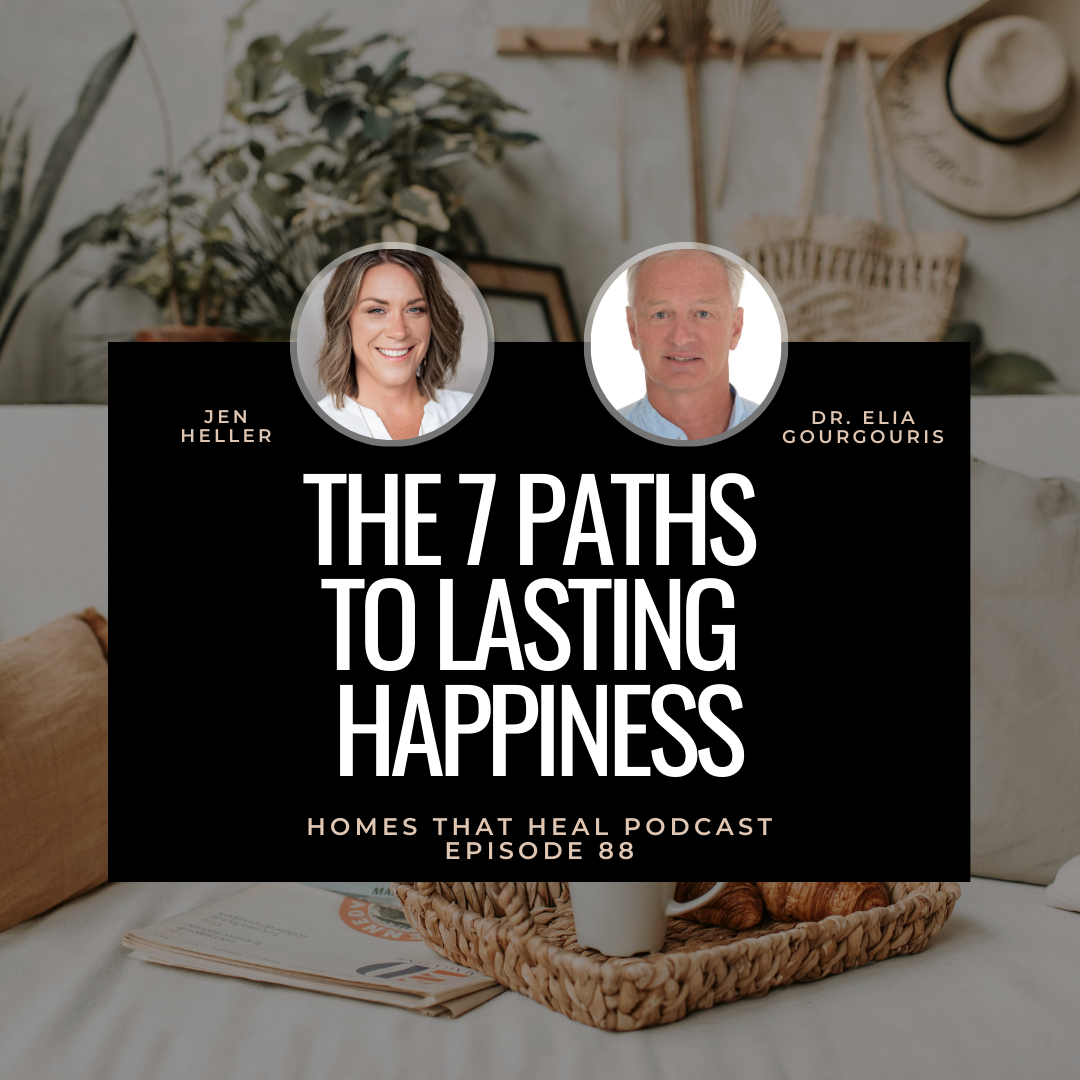
In this episode of Homes That Heal, I sat down with Dr. Elia Gourgouris—psychologist, bestselling author of 7 Paths to Lasting Happiness, and founder of The Kindness Factor International—to talk about what actually creates lasting happiness and why so many of us struggle to sustain it. His work, rooted in positive psychology and decades of clinical experience, offers a grounded roadmap for building happiness that supports mental health, relationships, and overall well-being.
But before we dive into the seven paths, let me share the story that changes everything.
The Brand You Didn’t Know You Were Wearing
The day Dr. Elia was born in Athens, Greece, his dad showed up at the hospital, looked through the nursery window at five identical babies wrapped in white blankets, and asked the nurse which one was his son. The nurse smiled and said, “Your son? He’s the happy one.”
And just like that, Dr. Elia was branded. He grew up hearing, “You came out of the womb happy. You’ve always been this way.”
But here’s the thing: What if his dad had been stuck in traffic? What if he’d shown up late, and baby Elia happened to be crying at that exact moment? The nurse might’ve said, “Your son? He’s the cranky one.” And Dr. Elia would’ve spent his childhood hearing a completely different story about who he was.
Same baby. Different label. Completely different life trajectory.
How Early Labels Shape Lasting Happiness
We’ve all been branded in some way. Whether it was “the smart one,” “the creative one,” “the athletic one,” or the far more damaging “the stupid one,” “the ugly one,” “the fat one.” These labels, given to us in childhood by parents, siblings, teachers, or classmates, become the lenses through which we see ourselves.
Dr. Elia spent 18 years as a clinical psychologist watching this pattern play out. Seventy percent of his patients—mostly women—were struggling not because of current circumstances, but because they were still wearing brands that no longer fit (if they ever did).
According to positive psychology, lasting happiness requires awareness of these stories—and the willingness to question them.
Releasing Old Stories to Create Lasting Happiness
After Dr. Elia shared his branding story at a conference, a woman in her 70s stood up, waving her arms, visibly moved. She told him that listening to his talk made her realize she’d been living under the brand “the stupid one” her entire life. At 70 years old, she decided to change it.
Seven decades of carrying a lie, and in one moment of clarity, she put it down and picked up the truth.
Lasting happiness becomes possible when we:
- Recognize outdated or harmful self-beliefs
- Separate who we are from who we were told to be
- Choose a personal narrative that supports growth and well-being
This isn’t about denial or rewriting history. It’s about reclaiming agency over your own story.
What Is Lasting Happiness?
One of the most important distinctions Dr. Elia makes is this: lasting happiness is not the same as feeling happy all the time.
It’s not about constant positivity, ignoring hard emotions, or pretending life doesn’t hurt sometimes. It’s about developing the internal tools that allow you to move through stress, loss, and uncertainty without losing your sense of self or hope.
From a mental health perspective, lasting happiness is deeply connected to:
- Emotional regulation
- Self-awareness
- Meaningful relationships
- Purpose-driven living
In other words, happiness isn’t something you stumble into. It’s something you build—with intention, patience, and practice.
The 7 Paths to Lasting Happiness Explained
While each path is interconnected, Dr. Elia emphasizes that lasting happiness is built through consistent, small practices, not dramatic life overhauls. You don’t need to master all seven at once. You just need to start where you are.
Let’s walk through what these paths actually look like in real life.
Path One: Self-Care as a Foundation for Mental Health and Lasting Happiness
Self-care is often misunderstood as indulgence or luxury. In reality, self-care is a mental health strategy.
Lasting happiness requires caring for:
- Physical health (sleep, movement, nourishment)
- Emotional needs (processing feelings, asking for help)
- Nervous system regulation (rest, breathwork, slowing down)
- Spiritual and mental well-being (whatever feeds your soul)
When self-care is neglected, happiness becomes fragile. When it’s prioritized, everything else becomes more sustainable.
Practical Self-Care for Lasting Happiness
This doesn’t mean bubble baths and face masks (though those are nice). It means:
- Creating consistent sleep routines
- Setting boundaries without guilt
- Listening to your body’s signals
- Allowing rest without having to earn it
Self-care isn’t selfish. It’s the foundation that makes everything else possible.
Path Two: Gratitude and Emotional Resilience
Gratitude isn’t about pretending everything is fine. It’s about strengthening emotional resilience even when things aren’t fine.
Research in positive psychology consistently shows that gratitude supports mental health, lowers stress, and increases overall life satisfaction. But here’s the key: gratitude works best when it’s honest, not performative.
Gratitude That Supports Lasting Happiness
Real gratitude looks like:
- Acknowledging what’s working alongside what’s hard
- Practicing gratitude during difficult seasons—not just good ones
- Using gratitude as a grounding tool, not a bypass for real feelings
Gratitude helps anchor happiness when circumstances are unstable. It doesn’t erase the hard stuff. It just reminds you that the hard stuff isn’t all there is.
Path Three: Kindness as a Pathway to Wellbeing and Lasting Happiness
Kindness isn’t just good for others—it’s essential for your own lasting happiness.
Through his work with The Kindness Factor, Dr. Elia highlights how kindness:
- Improves mental health
- Strengthens relationships
- Reduces isolation and burnout
- Supports emotional regulation
One of the most powerful stories from our conversation was about a woman in California who found a wallet with $185 cash in a Target parking lot. She could’ve kept it. Thrown it away. Taken the money. But she did the right thing—she returned it.
The owner, so moved by her honesty, decided to amplify that goodness. He founded RAK Week (Random Acts of Kindness Week), which spread to municipalities, cities, states, and eventually became a global movement recognized by the United Nations.
One wallet. One choice. Thousands of lives changed.
Why Kindness Starts at Home
Lasting happiness grows in environments where people feel seen, safe, and respected. That begins in our homes, our relationships, and how we speak to ourselves.
Kindness is not weakness. It’s a form of emotional intelligence. And it’s contagious.
Path Four: Relationships and Social Connection
Human connection is one of the strongest predictors of lasting happiness.
Healthy relationships support:
- Emotional safety
- Stress resilience
- Mental health stability
Conversely, toxic or misaligned relationships can quietly erode happiness over time, no matter how much self-care or gratitude you practice.
Creating Relationships That Support Lasting Happiness
This means:
- Communicating with honesty and compassion
- Setting boundaries that protect well-being
- Releasing relationships rooted in obligation rather than connection
You don’t need a huge circle. You just need a few people who actually see you and show up when it matters.
Path Five: Meaning and Purpose
Happiness deepens when life feels meaningful. Not perfect. Not polished. Just meaningful.
Purpose doesn’t have to be grand. It often shows up through:
- Meaningful work (paid or unpaid)
- Acts of service
- Creativity
- Contribution to something bigger than yourself
Dr. Elia splits his time between Boulder, Colorado, and his family village in Greece—a place where his roots go back 250 years. That kind of deep connection to place, to ancestry, to community? It’s grounding in a way that no amount of productivity hacks can replicate.
But you don’t need a Greek island retreat to tap into this. Meaning can look like:
- Cooking a meal that reminds you of home
- Helping a neighbor
- Creating something with your hands
- Showing up for the people you love
Lasting happiness grows when daily actions align with personal values.
Path Six: Mindfulness and Presence
Mindfulness supports lasting happiness by bringing awareness to the present moment.
When we’re constantly replaying the past or worrying about the future, happiness becomes inaccessible—even when good things are happening right in front of us.
Simple Mindfulness Practices for Lasting Happiness
You don’t need a meditation app or a yoga studio. You just need to:
- Slow down daily routines (actually taste your coffee)
- Pay attention to physical sensations (feel your feet on the ground)
- Create moments of stillness at home (even just five minutes)
Mindfulness isn’t about clearing your mind. It’s about noticing what’s actually happening without immediately trying to fix, change, or judge it.
Path Seven: Choosing Happiness Daily
Perhaps the most empowering path is this: happiness is a choice we practice daily.
Not a forced mindset. Not toxic positivity. But a commitment to:
- Self-awareness
- Compassion
- Growth
- Emotional responsibility
Lasting happiness isn’t passive. It’s participatory. It’s showing up for yourself the way you show up for everyone else.
And here’s the thing: creating a life you love doesn’t require perfection. It requires presence. Honesty. A little bit of courage. And the willingness to start again, even when you’ve stumbled.
Why Lasting Happiness Matters for Mental Health
When happiness is treated as optional or superficial, mental health suffers.
Lasting happiness supports:
- Nervous system regulation
- Emotional resilience
- Stress management
- Overall wellbeing
It creates a foundation where healing becomes possible. It’s not a luxury. It’s essential.
Bringing the 7 Paths to Lasting Happiness Into Your Home
At Homes That Heal, we talk often about creating environments that support wellbeing. Lasting happiness is influenced not only by mindset—but by the spaces we live in.
Consider:
- Is your home a place of rest or constant stimulation?
- Do your routines support calm or chaos?
- Are there spaces that invite connection, reflection, or gratitude?
Small changes in your environment can reinforce the internal work of happiness. Light a candle. Clear a corner. Create a spot where you can sit and breathe without anyone needing anything from you.
Final Takeaway: Lasting Happiness Is Built, Not Found
If there’s one message I hope you take from this conversation, it’s this:
You are not broken if happiness feels hard.
Lasting happiness is a skill set—one that can be learned, practiced, and strengthened over time.
Through self-care, gratitude, kindness, meaningful connection, and conscious mindset shifts, happiness becomes less fragile and more sustainable.
Dr. Elia’s work reminds us that happiness isn’t something you chase. It’s something you cultivate. That growth deepens when you decide that the brand you were given as a child doesn’t get to define the rest of your story.
When you show up for yourself the way you show up for everyone else? That’s when the real shift happens.
And here’s the thing: creating a life you love doesn’t require perfection. It requires presence. Honesty. A little bit of courage. And the willingness to start again, even when you’ve stumbled.
Start With One Small Shift
Pick one of the seven paths. Just one. And take one tiny step forward this week. Not a giant leap. Just a step.
Because lasting happiness isn’t built in a single moment. It’s built in a thousand small choices that say, I’m worth this. My peace is worth protecting. My joy is worth nurturing.
And honestly? You are.
Dr. Elia Gourgouris Bio
Dr. Elia Gourgouris also known as America’s Happiness Doctor, is an International Keynote speaker & the author of the #1 best-selling Amazon book, 7 Paths to Lasting Happiness. He’s the President and co-founder of The Kindness Factor International, which recently produced the highly acclaimed documentary feature film called For Such A Time As This on the impact of kindness worldwide! The first half of his career he built a thriving private practice as a Clinical Psychologist (all word of mouth) before moving on to become an Executive Coach working with C-Suite leaders.
With his Positive Psychology background and through his books, Keynotes, podcast interviews (350+ worldwide) and Executive Coaching he has helped hundreds of thousands of people both in their careers and in their relationships to achieve happiness and success in their personal and professional lives. As an inspirational speaker, he frequently presents at international conferences focusing on Happiness, Corporate Wellness & Mental Health. He’s the host of a new TV show called The Happy Hour w/ Dr. Elia on the Mental Health Television Network. He splits his time between the US and Greece/Europe.
Connect with Dr. Elia:
- Book: 7 Paths to Lasting Happiness: https://amzn.to/4rDeJRH
- Dr. Elia Gourgouris Website: https://www.dreliagourgouris.com/
- The Kindness Factor International: https://www.thekindnessfactor.com/
- LinkedIn: https://www.linkedin.com/in/thehappinessdoctor/
- Instagram: https://www.instagram.com/dr.eliag/
- Facebook: https://www.facebook.com/elia.gourgouris
Resources & Links
- Take a peek at my Jen Recommends list to see more of my favorite products.
- Grab my FREE Home Wellness Checklist here for more tips.
Be the first to know about my new favorite wellness tools, special deals, and more, subscribe to our newsletter!
Disclaimer: This podcast is for general information purposes only and does not constitute the practice of medicine, nursing, or other professional health care services. The statements and views expressed are not medical advice and are not meant to replace the advice of your medical doctor. This podcast, including Jen Heller and her guests, disclaims any responsibility and any adverse effects you may experience from the specific use of the information contained herein. The opinions of guests are their own and this podcast does not endorse or accept responsibility for the statements made by guests. The content of this podcast is not intended to be a substitute for professional medical advice, diagnosis, or treatment. If you think you have a medical condition, consult your licensed physician.


